By Marcus Kelvin | Updated: May 2026 | 14 min read | Kukri Comparisons
My buddy Dave showed up to a four-day camping trip with a hatchet. Solid one too — a Gransfors Bruks that his dad had given him. He was proud of that thing. We spent the first evening processing firewood and Dave was faster than me. No question. The hatchet split kindling in a way that felt effortless and rhythmic.
Then on day two we needed to clear a patch of scrubby undergrowth to pitch the tent properly. Dave started hacking at the brush with his hatchet and after about ten minutes, sweating, he looked at me using my kukri and said nothing. Just kept at it.
That weekend kind of stuck with me. Not because the kukri is magically better — it’s not — but because the gap between what each tool does well was more dramatic in practice than I had expected going in. They overlap, but not as much as people think.
I have been carrying kukris and occasionally hatchets for about twelve years now. This is everything I have worked out about when each one earns its place.
| SHORT ANSWER For firewood splitting and heavy log work, a good hatchet beats a kukri. For everything else — trail clearing, shelter building, food prep, brush, camp tasks — the kukri is more useful and covers more ground. The hatchet is a one-trick specialist. The kukri is a generalist. If you are carrying one tool for a multi-day trip with varied terrain, the kukri makes more sense for most people. If you know you will be splitting a lot of firewood and wood processing is the main job, bring the hatchet. |
What You Are Actually Comparing — The Tools Themselves
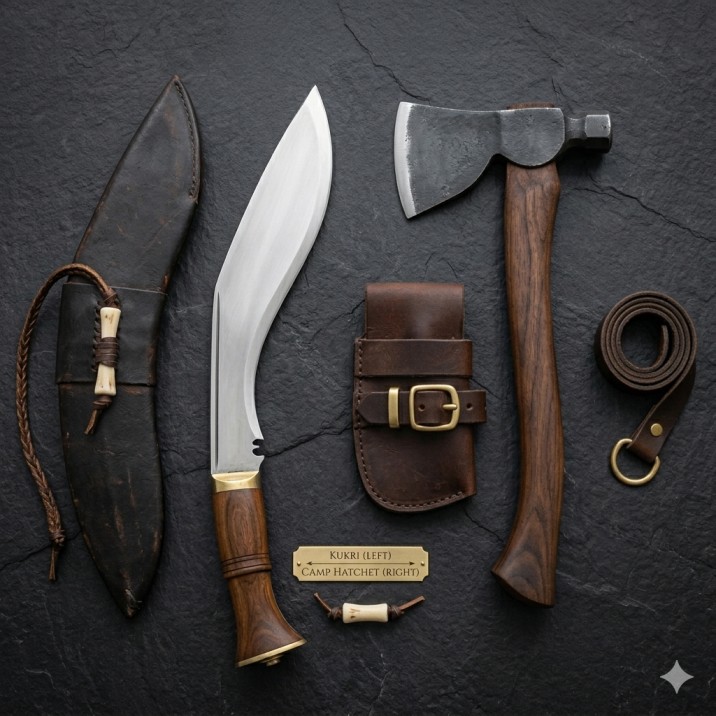
A kukri is a Nepalese field knife with an inward-curving blade, usually 9 to 12 inches of cutting edge. The curve is not decorative — it pushes the center of mass forward so the tip is accelerating when it hits. You feel that on impact. A well-swung kukri drives into wood differently than a straight blade of the same weight. The Gurkhas have been using these things in serious conditions for a couple of centuries, which should tell you something about how durable the design is.
A hatchet is a small single-handed axe. Blade is perpendicular to the handle, designed to be swung down onto wood. The geometry is entirely built around splitting — the head shape pushes wood fibers apart on impact. A decent camping hatchet weighs somewhere between 1.5 and 2.5 pounds with a handle around 14 to 18 inches. Most of the weight lives in the head.
People assume these tools overlap heavily because both are swung, both chop, and both live in the same gear bag. They do overlap, but the way they move through material is different enough that in practice you end up using them for distinct tasks.
| Feature | Kukri | Hatchet |
| Blade orientation | Inline with swing — like a knife | Perpendicular — like an axe |
| Weight | 500-900g typical | 700g-1.1kg typical |
| Length overall | 12-18 inches | 14-18 inches |
| Primary motion | Draw cut, chop, sweep | Overhead strike, split |
| Edge | Long curved edge — versatile | Short wide edge — split-focused |
| Precision tasks | Yes — can do fine knife work | No — handle shape limits it |
| One-handed use | Yes — controlled and natural | Yes — but limited to chopping |
| Sheath carry | Flat on belt, comfortable | Usually requires a pouch or loop |
| Multi-task range | Wide — clears, chops, preps food | Narrow — mainly wood processing |
| Durability | High — thick spine, full tang | Very high — steel head, hickory handle |
Where the Hatchet Beats the Kukri — Be Honest About This
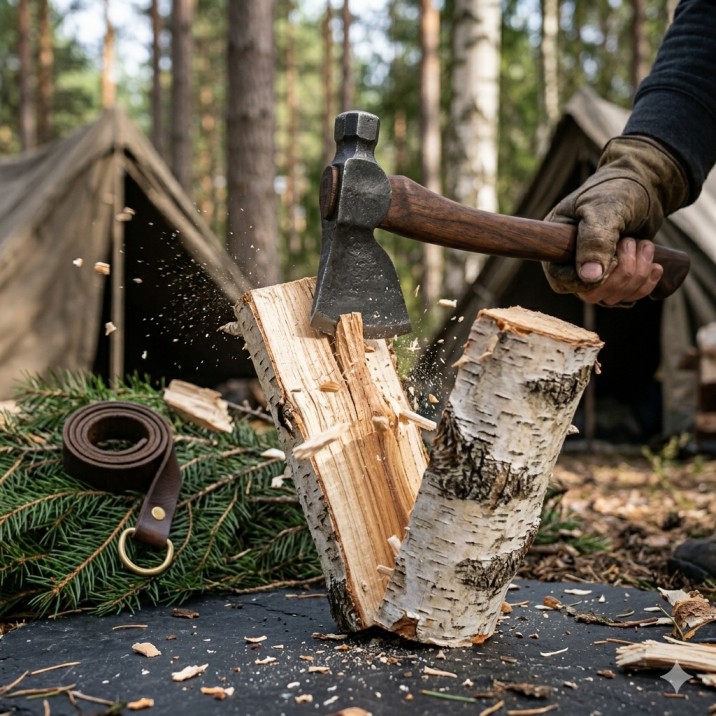
Splitting firewood. I am going to be straight here because I see a lot of kukri content that glosses over this. A hatchet splits better. Not a little better — noticeably better.
The geometry explains it. An axe or hatchet head is wedge-shaped from front to back, not just edge to spine. When it enters wood, the sides of the head are pushing the wood apart as it drives down. The wood splits around the tool. A kukri’s blade geometry is not designed for that. It is designed to cut along grain and across grain, to clear brush, to chop into wood — but the splitting action works differently and requires more strokes to get through the same piece.
Dave on that first evening — he was splitting kindling in two or three strikes that would have taken me five or six with the kukri. And he was fresher at the end of it because the hatchet was doing the work more efficiently. That is a real difference and I am not going to pretend it is not.
Batoning is another one. You can baton a kukri — drive the spine through a log using another log as a mallet — and it works fine. But a hatchet handle gives you a ready-made mallet right there. The workflow is just neater if you are doing a lot of log splitting in camp.
Heavy repeated wood processing over a full day is where the hatchet earns its place without argument. If you are building a serious base camp and spending hours splitting and processing logs, the hatchet will leave you less tired at the end of the day. The mechanics are just more efficient for that specific task.
| What the hatchet does not do well: Everything that is not wood splitting. Clearing brush and undergrowth is awkward with a hatchet — the short blade and perpendicular geometry means you are hacking rather than sweeping. Food prep is difficult. Fine work like notching or stripping bark is slow and imprecise. These are the tradeoffs you accept when you pack it. |
The specific cases where you should reach for the hatchet:
- Splitting firewood and kindling — this is its speciality and nothing beats it here
- Processing large rounds or green logs that need real splitting force
- Base camp setup where you know wood work will dominate your time
- Winter camping where you need a lot of firewood fast and dry splitting matters
- Paired with a separate fixed-blade knife, so you are not relying on it for camp tasks
Where the Kukri Has the Hatchet Beat — And It’s Most Things
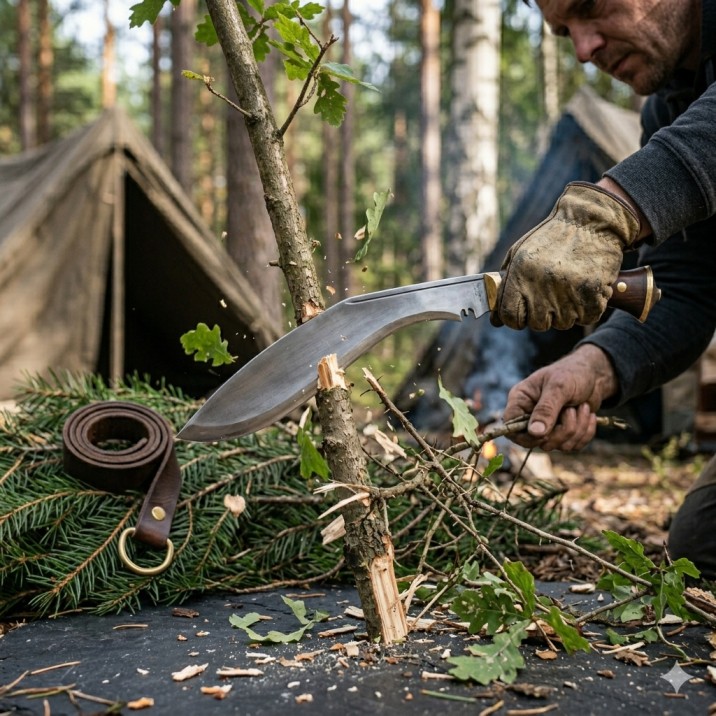
Everything that is not splitting firewood, basically.
Trail clearing is the first obvious one. You are hiking and there is a downed limb across the path, or a thick patch of brush, or low-hanging branches you need to take down. The kukri handles all of that in a way the hatchet does not. The sweeping motion, the long curved edge — you can clear twenty feet of overgrown trail in the time it takes to properly position yourself for a series of hatchet strikes on the same stuff.
Shelter building surprised me when I actually paid attention. I assumed the hatchet would be faster at cutting the poles you need for a lean-to or debris shelter. It is not — or at least, not by much. And for the finer work — notching the joints, stripping bark to get grip on the poles, trimming branches close to the trunk — the kukri is faster because it acts like a knife as well as an axe. You do not have to put it down and pick up a separate blade. You just use the belly of the kukri.
Food prep at camp is not even a competition. The hatchet is useless for it. The kukri does a reasonable job at most camp cooking tasks. It is not a chef’s knife, but you can break down meat, chop vegetables, slice bread, and open packaging without thinking about it. That utility matters when you are packing light.
Vines, soft woody stems, cane, undergrowth — all kukri territory. The sweeping cut the blade is built for handles that material efficiently. A hatchet through the same stuff is tiring and imprecise. You end up with bruised, crushed stems rather than clean cuts.
| Where people go wrong with the kukri on wood: Trying to split rounds the same way you would with a hatchet. The geometry is different. A kukri wants to chop and drive diagonally into wood, not split straight down through the center of a round. If you approach wood processing with kukri-specific technique — diagonal entry angles, working the grain rather than fighting it — you will get much better results. Fighting it like a hatchet is where people get frustrated and say the kukri cannot chop. It can. Just differently. |
When the kukri is the clear choice over the hatchet:
- Trail clearing and brush work — the kukri handles this without slowing down
- Shelter building — especially the fine work that needs knife-level precision
- Multi-day trips where your tasks will vary — the kukri adapts, the hatchet does not
- Food prep — any camp where you are cooking, the kukri earns its keep here alone
- Minimalist packing where you want one tool to cover as much as possible
- Warm weather camping where vegetation clearing is as common as wood work
- Survival situations — a kukri covers more contingencies than a hatchet
Task by Task — What Actually Happens in the Field
I want to go through the specific tasks rather than just talking in general terms. Because the general terms are where these comparisons get vague and unhelpful.
| Task | Kukri | Hatchet | Winner |
| Splitting firewood | Works but needs more strokes | Excellent — geometry built for it | Hatchet wins |
| Chopping small saplings | Fast and controlled | Awkward at close quarters | Kukri wins |
| Clearing brush / undergrowth | Excellent — sweeping cuts through it | Tiring and imprecise | Kukri wins |
| Batoning thick logs | Good on full-tang kukri | Handle doubles as mallet — efficient | Hatchet wins |
| Making kindling | Manageable but slower | Easy — a few strikes per piece | Hatchet wins |
| Shelter pole cutting | Fast — chops and trims in one tool | Decent on the chop, poor on the trim | Kukri wins |
| Notching and fine wood work | Excellent — acts like a heavy knife | Cannot do it — geometry too blunt | Kukri wins |
| Stripping bark | Easy with the belly | Nearly impossible | Kukri wins |
| Food prep at camp | Works well for most tasks | Essentially useless | Kukri wins |
| Vine and rope cutting | Clean — sharp belly cuts well | Awkward and inaccurate | Kukri wins |
| Emergency self-defense | Balanced and purpose-capable | Possible but awkward | Kukri wins |
| Snow and ice work | Manageable | Better — head weight breaks ice well | Hatchet wins |
| All-day repeated wood work | Tiring for pure splitting sessions | More efficient mechanically | Hatchet wins |
| Pack weight and carry | Lighter, flat on belt | Heavier, bulkier to carry | Kukri wins |
Kukri wins nine, hatchet wins five. But like I said before with the bolo comparison — look at which categories the hatchet wins. Every single one involves wood specifically. If your trip is heavily wood-oriented, those five wins matter a lot. If your trip involves varied terrain and mixed tasks, the nine kukri wins add up quickly in practice.
Weight and Pack Carry — It Adds Up Over Miles
A KA-BAR kukri runs about 530g. A Gransfors Bruks Wildlife Hatchet — a good mid-size camping hatchet — is around 600g just for the head, closer to 800g with the handle. A Fiskars X7 hatchet is around 850g total.
So the hatchet is heavier. Not dramatically, but over a long day on trail that extra 300 to 400 grams is something you feel. And carry position matters too. A kukri rides flat on a belt sheath — it stays put, distributes the weight close to the body, does not swing or shift. A hatchet usually goes in a loop or a specific hatchet pouch, and the head-heavy weight distribution means it tends to shift during movement. You notice it.
This is not a dealbreaker for most people. But if you are counting grams, or if you have a long approach hike before you get to camp, the kukri wins on carry comfort.
The One-Tool Question — What Do You Actually Pick?
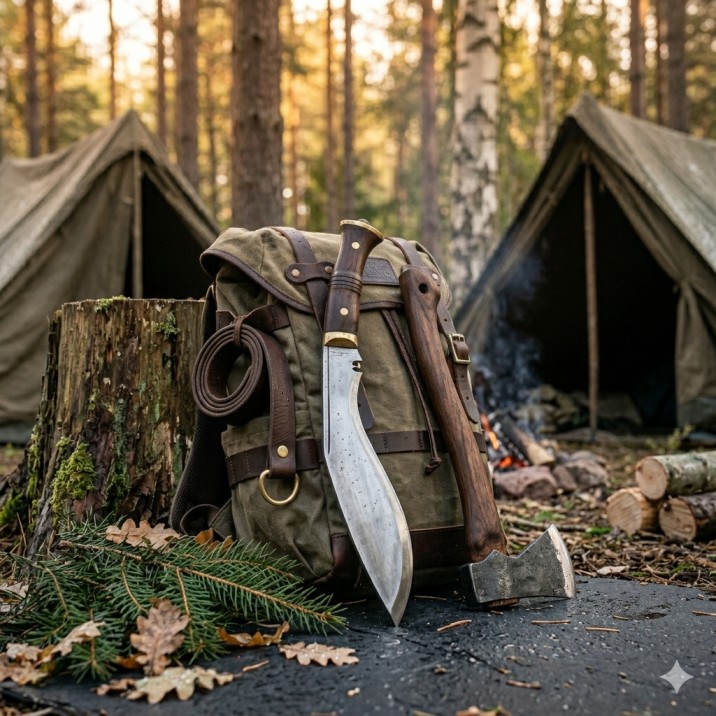
This is the question that actually matters for most people reading this. You are packing a bag and you have space for one large cutting tool. Which one goes in?
Kukri. Most of the time.
The reason is task coverage. The only thing you give up by choosing the kukri over the hatchet is efficient firewood splitting. Everything else, the kukri handles at least adequately and often better. If you are car camping or base camping and you know wood processing is the majority of what you will be doing, bring the hatchet. But for a multi-day hike-in trip where you do not know exactly what terrain you are dealing with, the kukri is the safer general-purpose choice.
The scenario where the hatchet wins the one-tool question is a winter basecamp situation. Cold, you need a lot of firewood every evening, you have a separate knife for camp tasks, and there is almost no trail work or brush clearing involved. That is the hatchet’s ideal environment. Outside of that scenario, I default to the kukri.
| What I personally carry: On most trips — kukri only. On winter trips over four days where I know I will be building sustained fires, I bring both. The kukri handles everything except the sustained splitting sessions, and the hatchet takes over for the hour each evening when I am processing wood for the night. The weight is worth it in that specific context. It is not worth it the rest of the time. |
Can You Bring Both — And Is It Worth the Weight?
Yes, and sometimes. Not always.
The total kit weight of a kukri plus a decent hatchet runs around 1.2 to 1.7kg depending on what you buy. That is a real chunk of your carry weight going to cutting tools. For a car camping trip or a canoe trip where weight is not the constraint, that is completely fine and you will not regret it. The hatchet splits, the kukri does everything else, you have no gaps.
For a multi-day backpacking trip where you are carrying everything, that same 1.5kg is a significant fraction of your tool weight. You need to make a call. Most experienced backcountry hikers end up picking one or the other rather than both.
The exception is cold weather trips, long base camp stays, or any situation where firewood is a daily high-volume requirement. In those cases the efficiency gain from the hatchet on splitting tasks offsets the carry weight. You will feel the difference at the end of a four-hour fire-prep session.
What I Would Actually Buy — Specific Picks
Best kukri for most buyers

| Spec | Detail |
| Model | KA-BAR 2-1249-9 Kukri Machete |
| Blade length | 11.5 inches |
| Steel | 1085 carbon — takes and holds a working edge |
| Handle | Kraton G rubber — stays grippy when wet |
| Construction | Full tang — reliable under real stress |
| Weight | ~530g |
| Price | ~$50 |
| Honest verdict | Three years of hard use. No failures, no complaints. |
This is the one I recommend to people who want a working kukri without spending $150 on a Himalayan Imports blade they are not sure they will use. The 1085 steel is not the fanciest carbon steel on the market but it is tough, it sharpens well, and it does not chip. The Kraton handle is genuinely comfortable for long sessions. The sheath that comes with it is okay but not great — worth upgrading if you care about that. The blade itself is excellent.
Best hatchet for most buyers

| Spec | Detail |
| Model | Gransfors Bruks Wildlife Hatchet |
| Head weight | ~600g |
| Handle | American hickory, 14 inches |
| Steel | Swedish steel — hand-forged, excellent edge retention |
| Weight total | ~800g |
| Price | ~$120-130 |
| Honest verdict | Expensive but correct. Dave’s lasted twelve years and counting. |
Yes, it is expensive for a hatchet. No, it is not a ripoff. Gransfors Bruks hand-forges each head in Sweden and the quality is genuinely different from the $35 hatchets at hardware stores. The edge comes sharp, holds longer, and the balance is right. Dave has had his for over a decade — same handle, same head, still performs like the first season. If you want a budget alternative, the Fiskars X7 at around $30 is a serious hatchet at a fraction of the price and I have no complaints about mine. But if you want the one you keep for twenty years, buy the Gransfors.
Honest Pros and Cons
Kukri
| What it does well | Where it falls short |
| Handles a wide range of tasks — clears, chops, preps, builds | Slower than a hatchet on sustained firewood splitting |
| Acts as knife and axe — you do not need a second tool | Curved edge takes more practice to sharpen correctly |
| Lighter and more comfortable to carry all day on trail | Less efficient on straight splitting cuts through large rounds |
| Works on vegetation, rope, food, and fine wood work | Heavier than a dedicated knife for pure cutting tasks |
| Covers survival scenarios better than almost any single tool | Requires technique — a hatchet is more forgiving to use badly |
Hatchet
| What it does well | Where it falls short |
| Splits firewood faster and with less effort than any knife | Useless for most camp tasks outside of wood processing |
| Durable — hickory handles and forged heads last decades | Heavy for what it does if wood work is not your primary task |
| Simple geometry — easy to use correctly even for beginners | Cannot do fine work — notching, stripping, food prep |
| Better for ice and frozen wood in winter conditions | Awkward to carry on belt compared to a sheathed kukri |
| Works as a hammer in a pinch for stakes, pegs, etc. | Cannot clear brush or trail without significant effort |
Things People Ask About This Comparison
Can a kukri replace a hatchet completely?
For most camping trips, yes. You give up some efficiency on firewood splitting and gain everything else. The only trips where I would say no — you genuinely cannot replace a hatchet with a kukri — are winter base camp situations where sustained high-volume firewood splitting is a daily reality. In those cases the hatchet’s mechanical advantage on splitting is too significant to ignore.
Can a hatchet replace a kukri?
No. A hatchet replaces one of the things a kukri does, and does that one thing better. It does not replace brush clearing, shelter building, food prep, vine cutting, precision wood work, or any of the other things the kukri handles. You end up needing a separate knife alongside the hatchet, which is basically admitting the hatchet alone is not enough.
Is a kukri better than a hatchet for survival?
Yes, pretty clearly. Survival situations are by definition unpredictable — you do not know ahead of time what tasks you will need to do. The kukri’s versatility covers more contingencies. A hatchet is fine if all you need to do is process wood, but if you need to clear trail, build a shelter, signal, prepare food, or deal with vegetation — the kukri is the better tool. The Gurkhas did not carry hatchets.
What about a kukri for splitting specifically — any tips?
Use the forward third of the blade, not the belly. Go in at a slight diagonal rather than straight down the center. Work the grain rather than against it. On a large round, make multiple entry cuts around the outside edge first rather than trying to drive through the center in one swing. It takes some practice to feel natural but once you get the angle right it is more effective than most people expect.
Does kukri quality matter more than hatchet quality for this comparison?
Yes, a bit. A cheap kukri feels terrible — light, thin, and the geometry is often wrong. A $30 kukri from a tourist shop is not what I am talking about when I say the kukri wins most tasks. Get something with real blade geometry and a full tang. On the hatchet side, even a cheap hatchet does the main job reasonably well because the geometry is simple. The difference between a $30 Fiskars and a $130 Gransfors is significant in feel and longevity, but both will split wood.
What I Think — No Hedging
The hatchet splits wood better. That is true and I am not going to keep qualifying it. If splitting wood efficiently is your main job, pack the hatchet.
For every other job on a camping or wilderness trip, the kukri is the more useful tool. It adapts. The hatchet does not. That adaptability is worth a lot when you do not know exactly what a trip will throw at you.
Dave — same buddy from the start of this — has a kukri now. Still has the hatchet too. But when he goes on a solo two or three day hike he takes the kukri and leaves the hatchet home. He told me he made the same firewood mistake I expected him to make, spending the first night fighting green wood with it before he figured out the angle. Now he does not think about it.
Most people who spend time genuinely using both tools end up landing in the same place. The kukri is the one you reach for more often. The hatchet is the one you are glad you have when you actually need it.
| Pick the Kukri if… | Pick the Hatchet if… |
| You are doing a multi-day trip with mixed terrain | Wood splitting is your primary and repeated task |
| You want one tool to handle camp tasks without a separate knife | You are in a fixed base camp for several days |
| You are packing light and counting carry weight | You are car camping and weight is not a factor |
| Trail clearing and brush work is part of your route | You are pairing it with a separate fixed-blade knife |
| Survival and emergency preparedness is on your mind | Winter camping where fire volume is high and sustained |
| Marcus Kelvin | Founder & Writer, BestKukriKnife.com 12 years carrying and testing field blades. Three Nepal trips, more than 60 kukris through my hands. Everything on this site is written and tested by me. No ghost writers, no affiliate-first recommendations. |