By Marcus Kelvin | Updated April 2026 | Kukri Buying Guides
Let me be direct before we get into anything. Under $100 is where most people start with kukris, and it is also where most people get burned. Not because there are no good blades in this range — there absolutely are — but because the difference between a $20 generic import and a $55 proper kukri feels small until you actually use them. One is a tool. One is a disappointment with a curve in it.
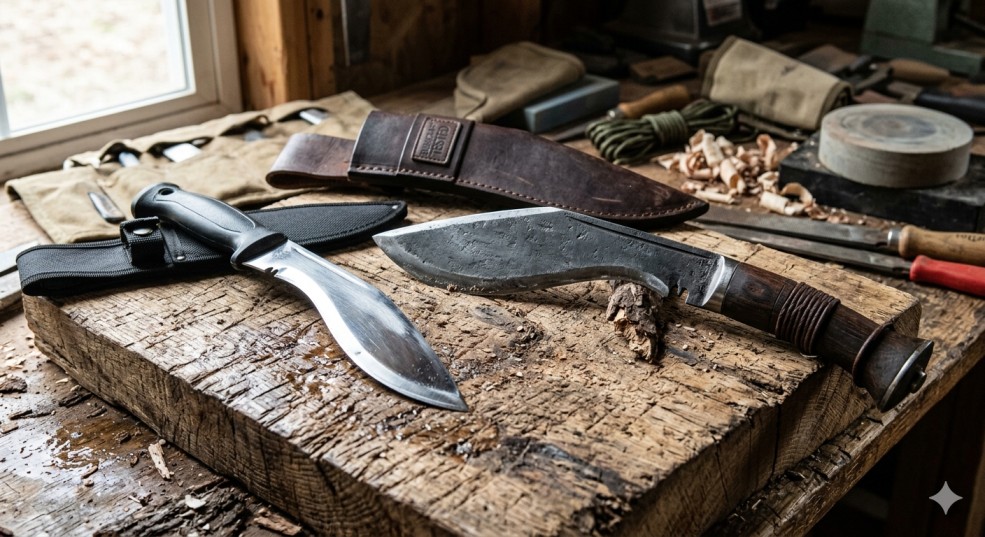
I’ve tested more than sixty kukris over fifteen years. I run wilderness courses where blades go through real work, not YouTube chopping tests. What I’m giving you here is my honest list of what’s currently available on Amazon under $100 and worth your money — with the specs, the real-world notes, and the stuff most reviews skip.
Quick Comparison Table
| Kukri | Blade | Steel | Weight | Sheath | Price | Best For |
|---|---|---|---|---|---|---|
| KA-BAR 2-1249-9 | 11.5 in | 1085 carbon | 1.3 lb | Leather/Cordura | ~$50 | Best overall |
| Ontario OKC 6420 | 11.5 in | 1095 carbon | 1.4 lb | Nylon | ~$50 | Best value |
| Cold Steel Gurkha Kukri Plus | 13 in | 1055 carbon | 1.6 lb | Cor-Ex | ~$80 | Most chopping power |
| Condor Heavy Duty Kukri | 9 in | 1075 carbon | 1.82 lb | Leather | ~$65 | Best traditional feel |
| Smith & Wesson Outback SWBH | 11.9 in | 7Cr17 stainless | 1.25 lb | Nylon | ~$35 | Best budget / low maintenance |
All five are full tang. I will not recommend a partial tang kukri at any price — if the steel doesn’t run the full length of the handle, it will eventually fail under batoning and you’ll have a dangerous situation on your hands.
1. KA-BAR 2-1249-9 — Best Overall Under $100
Specs: 11.5-inch blade · 1085 carbon steel · Kraton G handle · Full tang · Leather/Cordura sheath · ~$50

This is the one I hand to students on day one of my wilderness courses. Not because it’s the cheapest, but because it does what a kukri should do without any surprises. The 1085 carbon steel is tough under hard chopping impact — fractionally softer than 1095 but less prone to chipping when you baton through knotted wood or hit an unexpected knot mid-swing.
The Kraton handle is the real standout. In wet, cold, and muddy conditions — which is when grip actually matters — it locks into your palm. I have used cheaper handles that turn genuinely slippery the moment it rains. This one doesn’t. It also absorbs shock from chopping better than hard plastic or polypropylene handles, which you only appreciate after an hour of sustained work.
Honest complaint: the sheath. The leather and Cordura combination looks decent, has a useful auxiliary pocket, but the retention strap is loose on most examples I’ve seen. You can snap it closed and still pull the kukri out with one finger. For a blade this heavy swinging from your hip on a scramble, that’s a real issue. I add a leather lace wrap around the handle before trusting it in the field. Budget $25–30 for an upgrade sheath eventually.
Bottom line: Best $50 I’ve spent on a kukri. Buy this first.
2. Ontario OKC 6420 — Best Value
Specs: 11.5-inch blade · 1095 carbon steel · Kraton rubber handle · Full tang · Nylon sheath · ~$50
Ontario has been making this kukri for a long time. The formula hasn’t changed because it doesn’t need to. The 1095 carbon steel is the same grade you find in Becker knives and other blades costing three times as much — it holds a sharp edge and resharpens fast on any whetstone. The black coating wears off the cutting edge after the first few sessions of real work, which is normal and doesn’t affect anything.
Between this and the KA-BAR, the differences are small. The Ontario has slightly harder steel, which gives it marginally better edge retention under sustained chopping. The KA-BAR has a better sheath — though neither sheath is great, honestly. Both handle batoning without complaint. Both feel solid after extended sessions. If I couldn’t find the KA-BAR in stock, I’d buy this without hesitation.
The nylon sheath does stretch over time. The belt loop on mine started loosening after about eight months of regular use. Not a disaster, just worth knowing.
Bottom line: Nearly identical to the KA-BAR in real-world use. 1095 steel if you want slightly better edge retention.
3. Cold Steel Gurkha Kukri Plus — Most Chopping Power
Specs: 13-inch blade · 1055 carbon steel · Polypropylene handle · Full tang with steel guard · Cor-Ex sheath · ~$80

Cold Steel built this for raw power and it delivers. The 13-inch blade is the longest on this list, and with the weight pushed well forward, every swing hits harder than either of the 11.5-inch options above. When I need to process a lot of hardwood quickly at a base camp setup, this is the blade I grab. It gets through 3-inch rounds faster than anything else at this price.
The steel hand guard is worth calling out because no other kukri under $100 has one. When you’re batoning hard wood and the blade buries itself deep, a guard stops your hand from sliding onto the edge. It’s a legitimate safety feature, not a cosmetic choice.
The polypropylene handle is the one thing I’d change. Smooth from the factory, gets slippery with sweat during a long chopping session. My fix is one layer of paracord wrapped at the grip center — takes five minutes and completely solves it. The Cor-Ex sheath actually snaps shut with positive retention, which puts it ahead of the KA-BAR and Ontario sheath options.
The 1055 steel is softer than 1075 or 1095. It dulls slightly faster under hard sustained use. The extra reach and forward weight compensate for it on most tasks, but it’s worth knowing if you’re comparing spec sheets.
Bottom line: Buy this if you want maximum chopping reach and power. Nothing else at $80 comes close.
4. Condor Tool & Knife Heavy Duty Kukri — Best Traditional Feel
Specs: 9-inch blade · 1075 carbon steel · Walnut handle · Full tang · Leather sheath · ~$65

Every other blade on this list is a production tool that happens to be shaped like a kukri. The Condor is the closest thing to an authentic khukuri profile and feel at this price. Walnut handle, quality leather sheath, pronounced forward curve, 1075 carbon steel with an 8mm spine. It looks and feels the part in a way the others don’t.
The 9-inch blade is the shortest on this list, which makes it the most controllable for precise camp work — notching, stripping bark, fine detail cuts on shelter poles. It gives up reach on wide passes but the extra blade thickness and forward weight more than compensate for most chopping tasks. At 1.82 pounds for a 9-inch blade, it’s dense. That weight is in the right place — the swing has real authority.
The leather sheath is genuinely good. Thick, well-stitched, holds the blade securely. It’s the best factory sheath of anything on this list and the main reason I include this blade over cheaper alternatives with similar specs.
Walnut needs occasional oiling in wet environments. Leave it soaked in the sheath repeatedly and the wood can swell and crack at the handle scales. Basic maintenance prevents it completely.
Bottom line: The best sheath in this price range. Buy this if traditional aesthetics, sheath quality, and a shorter controllable blade matter to you.
5. Smith & Wesson Outback SWBH — Best for Low Maintenance
Specs: 11.9-inch blade · 7Cr17MOV stainless · Rubber handle · Full tang · Nylon sheath · ~$35
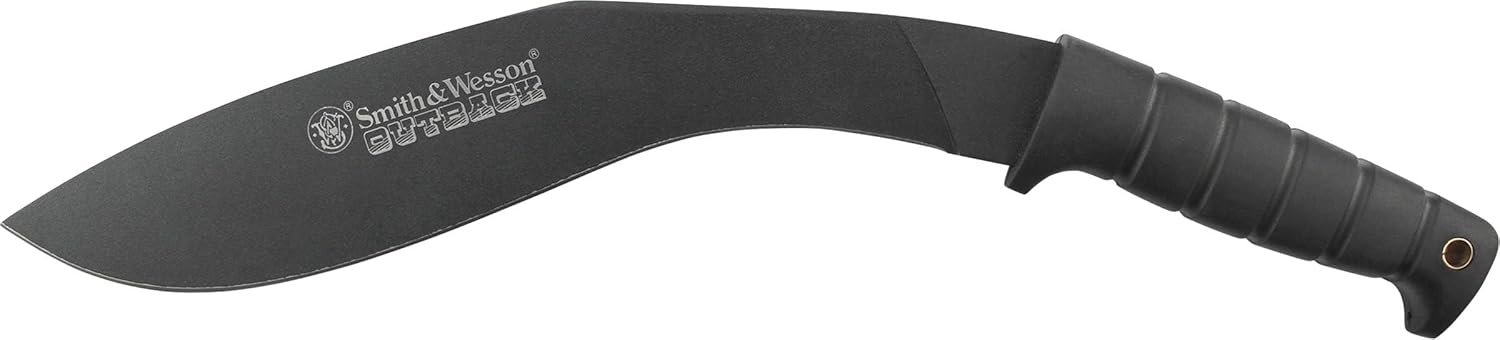
I want to be upfront about the stainless steel before you read further. 7Cr17MOV is not a premium grade. It dulls faster than 1085 or 1095 carbon under hard sustained chopping. If you’re processing firewood for hours this needs more frequent touch-ups than the carbon options above. That’s just the honest truth.h
What it trades for is zero maintenance headaches. No oiling after wet sessions. No rust risk from leaving it in the sheath after a rainy trip. No surface bloom if you forget about it for a month. For campers who want a kukri they can throw in a gear bin between trips and not think about, this is genuinely the right choice.
At $35 it’s also the lowest-risk way to find out whether you even like the kukri format. If you use it and love it, upgrade. If you use it a few times and it sits in the drawer, you’re out $35 rather than $80.
The nylon sheath is basic. It works. Don’t expect more than that.
Bottom line: Best for low-maintenance casual use or first-time buyers who aren’t sure yet whether they’ll stick with kukris.
What to Look For Before You Buy
| Feature | What You Want | What to Avoid |
|---|---|---|
| Tang | Full tang only | Partial or rat-tail tang — fails under batoning |
| Steel | 1075, 1085, or 1095 carbon | Unspecified “stainless” or anything under 420 grade |
| Blade thickness | 5mm minimum at spine | Under 3mm — flexes under impact |
| Handle | Kraton rubber, Micarta, or quality hardwood | Smooth polypropylene without modification |
| Sheath | Leather, Kydex, or Cor-Ex with positive retention | Loose nylon with no snap — safety issue on a moving belt |
| Minimum spend | $40 for a field-capable blade | Under $30 — these are props |
The Sheath Problem Nobody Talks About
Every blade on this list has a sheath issue except the Condor. The KA-BAR and Ontario retention is genuinely poor. The S&W is basic nylon. The Cold Steel Cor-Ex is the best of the bunch and still not impressive.
If you buy any of these — and you should — budget an extra $25–35 for a replacement leather or Kydex sheath. A kukri this heavy sliding off your belt during a scramble or a creek crossing is not just an inconvenience. It’s a hazard. The manufacturers cut costs on sheaths at this price point across the board. The blade is worth the upgrade. The sheath usually isn’t.
My Honest Pick for Each Situation
First kukri, trying the format: Smith & Wesson Outback at $35. Low risk, good enough to know whether you like the format.
Best field performance under $100: KA-BAR 2-1249-9. Proven steel, full tang, reliable handle, best overall performance at the price.
Maximum chopping power: Cold Steel Gurkha Kukri Plus. 13-inch blade with a hand guard. Nothing else at $80 touches it for raw force.
Traditional feel, best sheath: Condor Heavy Duty. The walnut and leather setup is genuinely well-made.
Don’t care about rust, just want it to work: Ontario OKC 6420. 1095 steel, full tang, straightforward.
FAQ
Is a $50 kukri actually any good? At $50 you get a full-tang 1085 or 1095 carbon steel kukri from KA-BAR or Ontario — both of which I trust with sustained field use. The quality gap between $50 and $150 is real but smaller than you’d expect. What you’re paying for above $100 is better sheath quality, thicker blade geometry, and more refined materials. The $50 blades do the work.
Should I buy carbon steel or stainless? Carbon steel for serious field use. 1085 and 1095 hold better edges under hard chopping and are tougher than entry-level stainless. Stainless if you want low maintenance and rust resistance for occasional camping. The S&W Outback is the right stainless choice in this price range.
Can I baton with any of these? Yes, all five are full tang and handle batoning. Don’t baton with a partial tang kukri regardless of what it costs — the handle will eventually fail and that’s a dangerous situation.
What’s the minimum I should spend? $40 for a genuine field tool. Below $30 the steel is too soft and the construction too weak for real use. A $15 Amazon kukri is not a kukri.
Do I need to sharpen it before first use? Almost certainly yes. Most production kukris arrive with a factory edge that’s functional but not properly sharp. Spend 10 minutes on a medium whetstone before your first field session. The difference is immediate.
Marcus Kelvin is the founder of BestKukriKnife.com. He has tested 60+ kukri knives over 15 years of wilderness courses and field use in the Pacific Northwest.