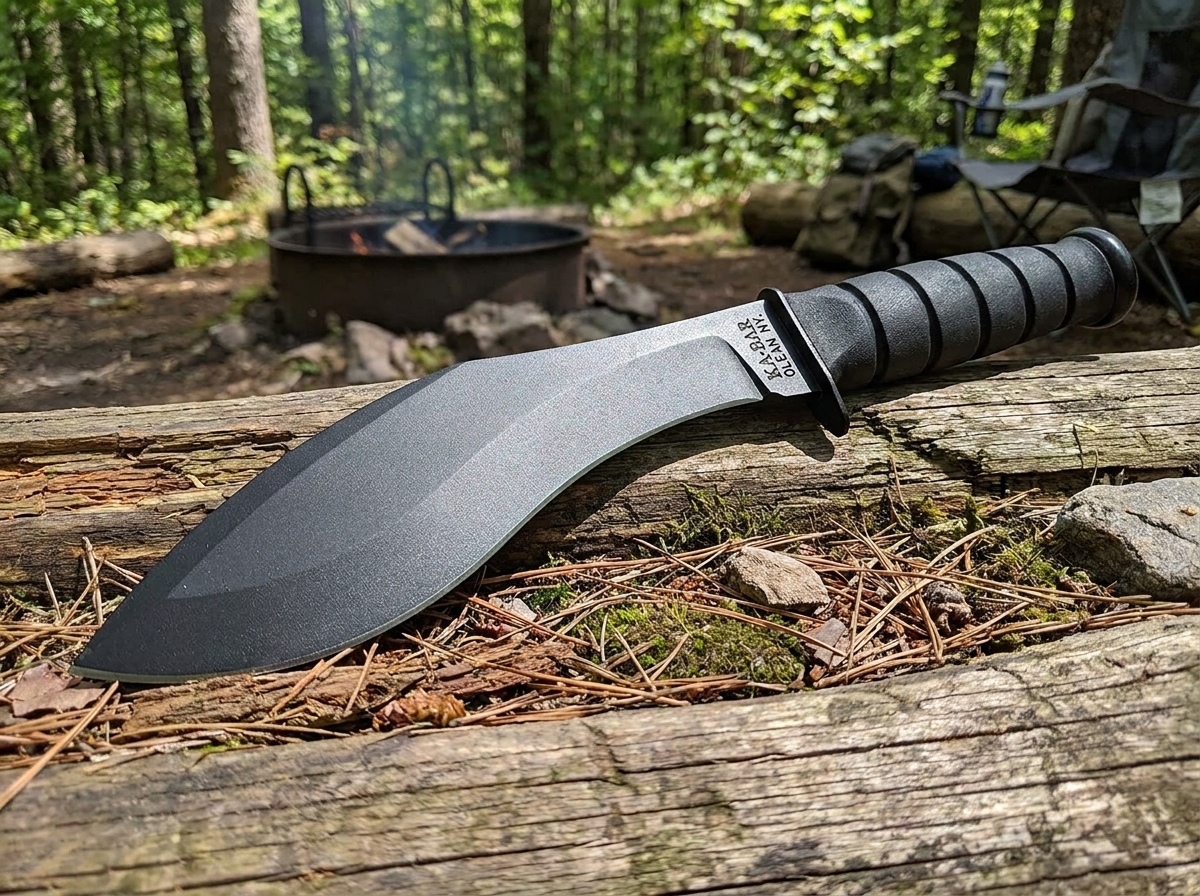
I bought my first KA-BAR Combat Kukri about three years ago after spending way too long reading forum threads about it. Half the people said it was the best budget kukri on the market. The other half said it was a disappointing machete that KA-BAR slapped a kukri name on to sell to people who do not know better.
After three years — a fair amount of camping, some genuinely hard field use, and one trip where it was the only cutting tool I had for five days — I have a pretty clear picture of which camp was right. Spoiler: it is more complicated than either side was making it.
This is a full review. I am going to go through the blade, the handle, the steel, the sheath, and the actual performance on the tasks people use these for. I will tell you what it does well, what it does badly, and who should and should not buy it. If you want the short version, skip to the verdict section. If you want to understand the blade properly, read the whole thing.
| 8.1 / 10 — Recommended with caveats The KA-BAR Combat Kukri is a genuinely capable field blade at a price that makes almost every competitor look overpriced. The steel is good, the geometry works, and the full-tang construction is solid. The sheath is weak and the handle is only okay. For $55, it earns its place — but know what it is before you buy it. |
Specs at a Glance
| Specification | Detail |
| Model | KA-BAR Combat Kukri — Model 2-1249-9 |
| Blade length | 11.5 inches |
| Overall length | 17 inches |
| Blade thickness | 4.5mm at the spine |
| Steel | 1085 carbon steel |
| Finish | Black epoxy powder coat |
| Handle material | Kraton G thermoplastic rubber |
| Construction | Full tang |
| Weight (blade only) | ~530g (18.7 oz) |
| Weight with sheath | ~730g |
| Sheath material | Leather and Cordura nylon combination |
| Country of manufacture | Taiwan |
| Price (current) | ~$50-60 |
| Warranty | KA-BAR limited lifetime |
Out of the Box — First Impressions
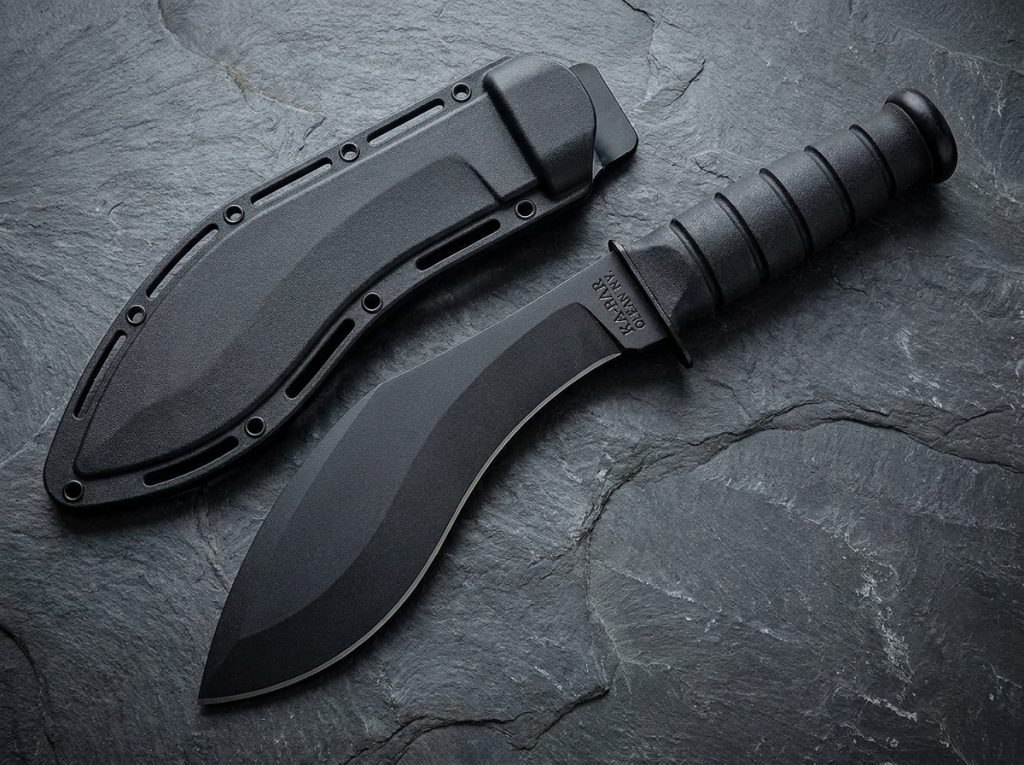
When it arrived I took it out and held it for a few minutes before doing anything else. That probably sounds odd but I do this with every blade — just hold it, feel the balance, see where the weight sits. It tells you a lot before you ever make a cut.
The balance point on the Combat Kukri is about an inch ahead of the guard. That is forward-heavy, which is what you want on a kukri. The blade pulls the tip into the cut rather than requiring you to muscle it in. Compared to a few cheaper kukris I have handled where the balance sits at the guard or even behind it, this feels like it was actually engineered rather than just shaped.
The powder coat on the blade is thick and even. No bare spots, no thin patches at the spine. The Kraton handle has a slight tacky texture to it — not sticky, just not slippery. In the hand it feels substantial without feeling heavy. The choil — the unsharpened notch at the base of the blade where it meets the handle — is cleanly cut and gives a decent grip position for controlled cuts.
Edge out of the box was serviceable. Shaving-sharp it was not, but it would push-cut paper cleanly and slice through rope without dragging. For a production blade at this price that is about what you expect. I put it through a few passes on a ceramic rod and stropped it on leather before the first real use session.
The sheath. We will talk about this more later. First impression was: functional, not impressive. The Cordura backing is fine, the leather throat has decent retention. But it felt like an afterthought compared to the blade.
The Blade — Geometry, Steel, and Edge
Geometry
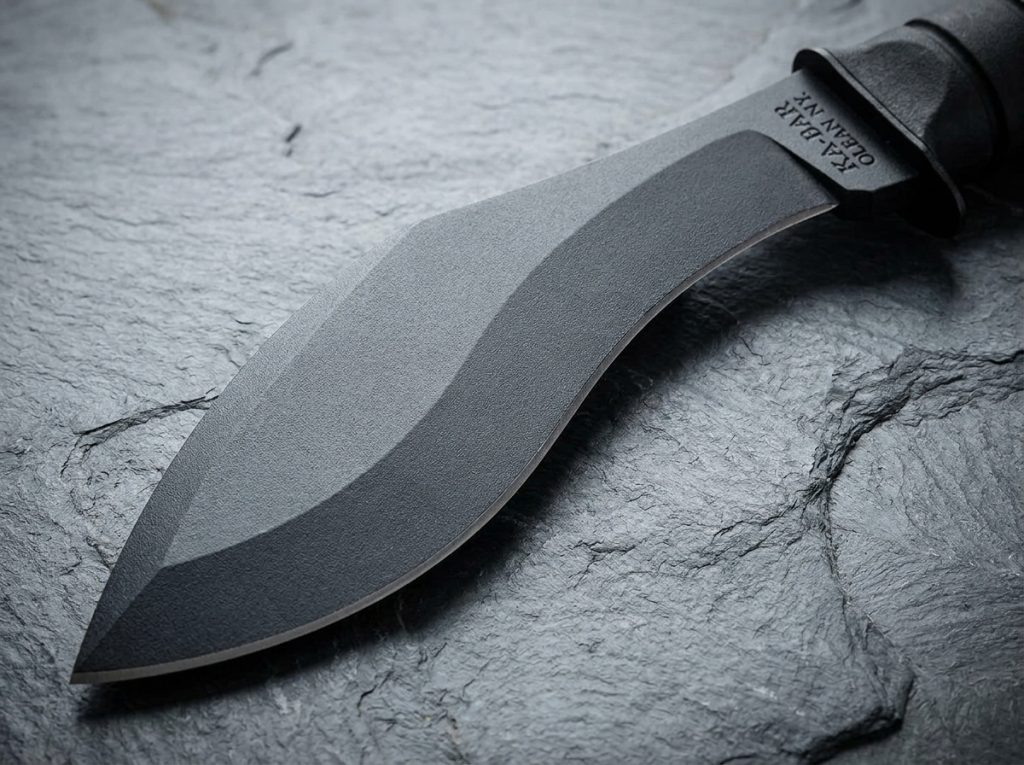
The blade profile is a proper kukri curve — not a half-hearted one. Some budget kukris look like someone drew a gentle S-curve on a straight blade and called it done. The Combat Kukri has a real forward sweep with a defined belly and the tip sitting noticeably below the handle centerline. When you swing it, the tip drives downward into the cut the way a kukri should.
At 11.5 inches of blade, it sits in the middle of the kukri size range — long enough for real chopping work, short enough to control for finer tasks. I have used 14-inch kukris that were faster on brush clearing but felt clumsy for anything requiring precision. I have used 9-inch kukris that were precise but could not move serious material. The 11.5-inch length is a reasonable compromise. It is the right size for a general-purpose carry.
Spine thickness is 4.5mm. That is on the thinner side for a kukri — a Himalayan Imports blade at the same length runs 7 to 8mm. What you lose in batoning mass you gain in overall weight and swing speed. For a blade designed for field use rather than pure wood processing, 4.5mm is workable. I have batoned it through 4-inch green logs without issue. I would not push it on anything larger.
The 1085 steel
1085 is a high-carbon steel with a carbon content around 0.85%. It is not fancy. It is not the steel people talk about when they are comparing premium knives. What it is — tough, easy to sharpen, and reasonably resistant to chipping under hard use. It holds an edge longer than most stainless steels you would find at this price point, and when it does lose its edge it degrades gradually rather than suddenly going from sharp to useless.
The tradeoff with 1085 is rust. Carbon steel rusts, and this blade will show surface rust if you leave it wet and neglect it. After five days in damp Pacific Northwest conditions on that longer trip I mentioned, I had light surface rust on about a third of the blade where the powder coat had taken minor scratches. It cleaned off easily with oil and a rag. But if you are not the type to maintain your blades, be aware this requires more attention than a stainless steel blade.
The heat treat on KA-BAR’s production 1085 lands around 56-57 HRC based on what they have published. That is soft enough to resharpen easily in the field with basic tools, hard enough to hold a decent working edge. Not the 58-60 HRC you would want on a fine slicing knife, but appropriate for a chopper.
| Field sharpening note: I have sharpened this blade with a Lansky puck, a DMT diamond card, and a piece of sandstone I found at a creek bed. All three worked. The 1085 responds well to almost any abrasive, which matters when you are in the field without your full sharpening kit. The rolling wrist technique on the curved belly takes a little practice but once you have it the blade gets sharp quickly. |
Edge retention — honest numbers
I use a rough test on field blades: how many times can I chop through a 2-inch green birch branch before the blade starts dragging noticeably rather than cutting cleanly? With the Combat Kukri fresh off a strop, I got around 40 to 50 clean chops before I noticed the edge starting to work rather than slice. That is better than the Cold Steel Kukri Machete I tested a couple of years ago and worse than a properly heat-treated Himalayan Imports blade. For $55, it is more than acceptable.
The Handle — Where It Gets More Complicated

The Kraton G handle is the part of this blade that splits opinion, and after three years I understand why.
Kraton is a thermoplastic elastomer — basically a synthetic rubber. It does not absorb moisture, does not swell or crack in wet conditions, and stays grippy when your hands are wet or cold. These are real advantages in field conditions. My wood-handled kukris require more maintenance and occasionally show swelling at the handle-blade junction after serious rain. The Kraton handle on the Combat Kukri has never had that problem.
The shape is where it gets mixed. The handle has a slight palm swell in the middle and the front guard curves down enough to prevent the hand sliding onto the blade during hard chops. That part works. The problem is the handle diameter — it is on the larger side, thick enough that people with smaller hands find it tiring over long sessions. My hands are medium-sized and I find it comfortable for sessions up to an hour. A friend of mine who does wilderness courses and has smaller hands found it fatiguing after about twenty minutes of repeated chopping. That is a real limitation and worth knowing about before you buy.
There are no finger grooves, which I actually prefer on a field blade. Grooves lock your grip position in a way that feels good until you need to shift your grip for a different task, and then they work against you. The smooth palm swell of the Combat Kukri lets you adjust your grip without fighting the handle shape.
The pommel is a small rounded cap. It does nothing special — no glass breaker, no lanyard hole that sits correctly, no secondary function. It keeps the handle together and that is it. Fine.
| Handle fit issue to know about: On my first blade, the Kraton scales had a slight gap at the base where they met the guard. Not a structural issue — full tang construction means the blade’s integrity does not depend on the scales — but it looked rough and caught debris over time. I have seen this reported by other owners. Check yours when it arrives. If the gap bothers you, a small amount of black epoxy fills it cleanly. KA-BAR’s warranty covers fit and finish defects if you prefer to go that route. |
The Sheath — The Honest Weak Point
The sheath is the worst part of this blade. Not by a small margin.
It is a Cordura nylon backing with a leather throat and a snap strap retention. The blade fits into it with adequate retention — it does not fall out if you are moving around, and the snap strap adds security when you need it. The belt loop is wide enough to fit most belts without issue.
The problem is longevity and protection. After about eighteen months of regular use, the leather throat on mine started to crack at the seam where it stitched to the Cordura. It did not fail completely but it looked rough and the stitching started fraying. The snap on the retention strap also got stiff and required deliberate force to close and open, which is annoying when you are trying to use the blade repeatedly in the field.
Several people I know who carry this blade have replaced the sheath within the first year. The blade itself is fine — the sheath holds it back. A Kydex custom sheath from a small maker runs about $40 to $60 and dramatically improves the whole package. It is frustrating to spend that on a blade that costs $55, but the blade itself justifies it if you are planning to carry this seriously.
If you are not planning to use this hard and the sheath just needs to hold the blade at home or in a pack between trips, it is fine. If this is a working carry you will put real hours on, budget for a sheath replacement.
Performance — What I Did With It and What Happened
Chopping and wood processing
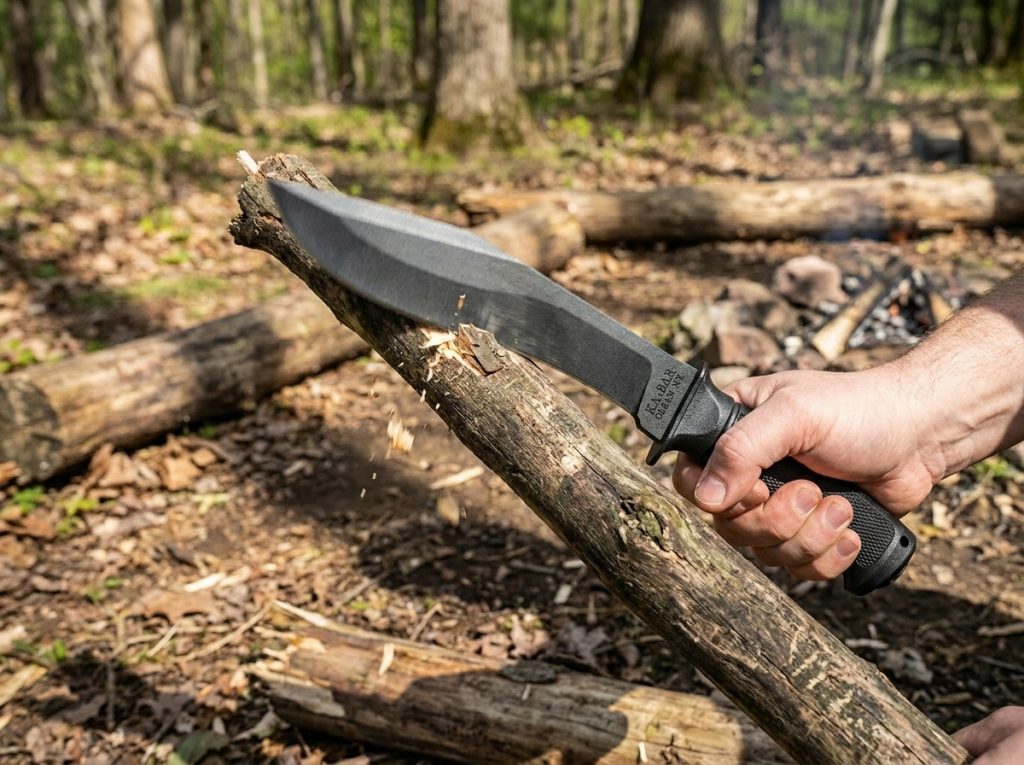
This is the task most people buying a combat kukri will use it for most. Three years in, I have used this blade on everything from green alder saplings to dried pine. The verdict: it chops better than it has any right to at this price.
The geometry does the work. The forward-weighted tip accelerates into the cut and the inward curve channels the force correctly. On green wood up to about 3 inches in diameter, the Combat Kukri is fast and efficient. I can process an evening’s worth of camp firewood in about twenty minutes — that includes limbing, sectioning, and making kindling from the smaller pieces.
Green wood over 4 inches in diameter is where the 4.5mm spine starts to feel thin. The blade buries itself fine on the entry stroke but does not have the mass to push through on a single hit. You end up working the blade out and re-entering rather than splitting cleanly through. For serious heavy wood processing, a thicker-spined blade or a hatchet is a better choice. For camp-scale wood work, this handles it.
Batoning: I have batoned through logs up to about 4 inches without issue. I push the blade in using a baton struck against the spine. At 4.5mm the spine is thinner than ideal but 1085 steel is tough enough to handle the lateral force without bending. I would not do this repeatedly on a 6-inch green log — that is asking more than the blade was designed for. On typical camp-scale batoning it is fine.
Brush clearing and trail work
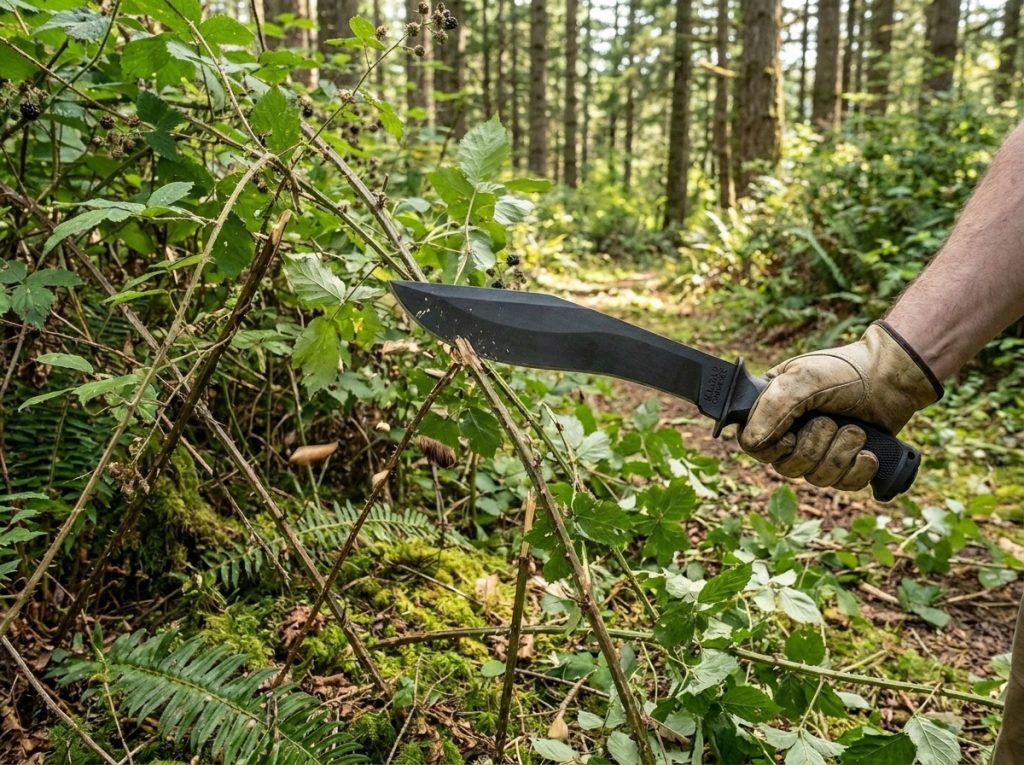
Where this blade surprised me most. The 11.5-inch edge with a proper kukri curve sweeps through light to medium brush in a way that felt more efficient than I expected from a blade this size. On a trail clearing session in the Cascades where I was cutting back about 80 feet of overgrown trail, I was moving at a good pace. The swing arc is natural, the blade does not want to hook on material the way some narrower kukris can, and the weight behind each stroke lets the blade do the work rather than requiring you to muscle through.
Heavy vegetation — blackberry canes, thick-stalked shrubs, dense salal — takes more effort but still moves. This is not a machete; you are not going to clear an acre of subtropical scrub with it. But for typical trail maintenance or campsite clearing, it is a competent tool.
Shelter building
Three seasons ago I ran a solo five-day trip where the Combat Kukri was my only cutting tool by design — I wanted to find out what it could and could not cover. Shelter building was on the list.
Cutting the poles for a debris shelter: fast, no issues. Limbing and trimming: the belly of the blade does fine work when you slow down and use it deliberately rather than swinging. Notching joints: this is where I felt the blade most. The tip is not as precise as a dedicated carving blade, but by using the forward quarter of the edge in controlled short strokes I got usable notches. Slower than I would have liked, but it worked.
Bark stripping: clean and easy using the spine as a scraper and the belly for the longer pulling cuts.
Conclusion on shelter work: it handles it. Not as efficiently as a dedicated bushcraft knife for the fine work, but the fact that one blade covered chopping and fine work without me reaching for a second tool is exactly what a field kukri should do.
Food prep
Decent. The wide belly makes a reasonable camp kitchen blade. I have broken down rabbits with it, chopped vegetables, sliced bread, opened cans with the tip. The powder coat on the blade does mean you want to clean it well after food contact — carbon steel plus food residue plus moisture is a rust invitation. But with basic maintenance it is fine.
I would not use it as a primary camp kitchen knife if I had other options. But as part of a one-blade kit it covers food prep without complaint.
Category Ratings
| Category | Score | Notes |
| Blade geometry | 5 | Proper kukri curve, correct balance point, well-executed profile |
| Steel quality | 4 | 1085 carbon is honest and capable — rusts without maintenance |
| Edge retention | 4 | Better than budget stainless, below premium carbon steel |
| Handle comfort | 3 | Kraton works in wet/cold — diameter too large for smaller hands |
| Handle durability | 5 | Kraton does not rot, crack, or swell — outlasts wood handles |
| Sheath quality | 2 | Functional for the first year, deteriorates with real use |
| Chopping performance | 4 | Efficient on camp-scale wood work, limited on heavy logs |
| Brush clearing | 4 | Sweeps through light to medium vegetation well |
| Precision tasks | 3 | Manageable but not its strength — tip geometry is adequate |
| Value for money | 5 | Hard to beat at this price — this blade costs twice this elsewhere |
| Build quality overall | 4 | Full tang, solid construction — sheath is the weak link |
How It Compares to the Other Options at This Price
Most kukri buyers are also looking at a few other blades in the same range. Here is how the Combat Kukri sits against the ones I have used.
| Blade | Price | Steel | Spine | Sheath | Best for |
| KA-BAR Combat Kukri | ~$55 | 1085 carbon | 4.5mm | Mediocre | General field use, camping, trail work |
| Cold Steel Kukri Machete | ~$45 | 1055 carbon | 3mm | Basic nylon | Light brush clearing, budget carry |
| Condor Tool & Knife Kukri | ~$70 | 1075 carbon | 6mm | Leather (decent) | Heavier wood work, bushcraft |
| Schrade SCHF9 Kukri | ~$40 | 8Cr13MoV stainless | 5mm | Nylon (poor) | Very light use, budget option |
| Ontario Knife Co. Kukri | ~$60 | 1075 carbon | 5mm | Nylon (okay) | Military-style carry, durability |
| Himalayan Imports Kukri | ~$150+ | Carbon steel | 7-8mm | Leather (good) | Serious wood work, premium build |
The Cold Steel Kukri Machete is cheaper but the 1055 steel and 3mm spine make it feel flimsy next to the KA-BAR. Fine for light use; not the same tool. The Condor is a better blade overall — thicker spine, better sheath, slightly better steel — but it costs $15 more and that matters at this end of the market. The Himalayan Imports blades are in a different league but cost three times as much and you are buying a handmade product with the variability that comes with it. For most buyers the KA-BAR sits at the best cost-to-capability ratio in this tier.
Who Should Buy This — and Who Should Not
Buy it if:
- You want a capable field kukri without spending over $100 — this is the best value in that category
- You are new to kukris and want a first blade to learn on before investing in something pricier
- Your primary uses are camping, trail work, brush clearing, and camp-scale wood processing
- You camp in wet or cold conditions where a Kraton handle is more practical than wood
- You are happy to replace or upgrade the sheath — the blade itself earns its keep
- You want a capable workhorse you are not afraid to abuse — something about spending $55 makes you less precious about it
Do not buy it if:
- Heavy daily wood splitting is your primary task — get a thicker-spined blade or just use a hatchet
- You have small hands — the handle diameter will tire you out on long sessions
- You expect the sheath to last more than a year of regular hard use without replacement
- You want a blade that looks good — the black powder coat is functional but plain
- You are comparing it to Himalayan Imports or similar traditional makers — different category, different price, different conversation
Keeping It Right — Maintenance Notes
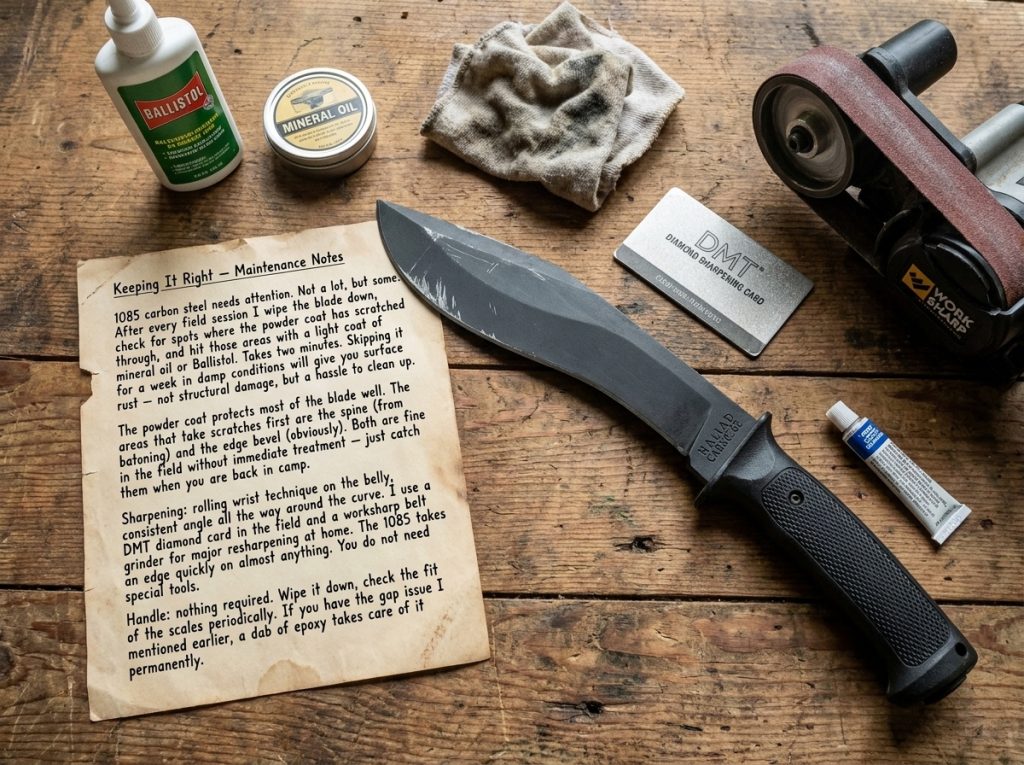
1085 carbon steel needs attention. Not a lot, but some. After every field session I wipe the blade down, check for spots where the powder coat has scratched through, and hit those areas with a light coat of mineral oil or Ballistol. Takes two minutes. Skipping it for a week in damp conditions will give you surface rust — not structural damage, but a hassle to clean up.
The powder coat protects most of the blade well. The areas that take scratches first are the spine (from batoning) and the edge bevel (obviously). Both are fine in the field without immediate treatment — just catch them when you are back in camp.
Sharpening: rolling wrist technique on the belly, consistent angle all the way around the curve. I use a DMT diamond card in the field and a worksharp belt grinder for major resharpening at home. The 1085 takes an edge quickly on almost anything. You do not need special tools.
Handle: nothing required. Wipe it down, check the fit of the scales periodically. If you have the gap issue I mentioned earlier, a dab of epoxy takes care of it permanently.
Questions People Ask Before Buying This
Is the KA-BAR Combat Kukri a real kukri or just a kukri-shaped machete?
Real kukri. The geometry is correct — inward curve, forward-weighted balance, belly-heavy profile. A machete is longer, thinner, and straight or very slightly curved. The Combat Kukri chops the way a kukri should rather than sweeping the way a machete does. It is a legitimate kukri design, not a marketing label on a different blade type.
Can it replace a dedicated survival knife?
Yes, for most survival tasks. It clears brush, processes wood, builds shelter, preps food, and does fine work when you need it to. Where it falls short compared to a 5 to 6 inch fixed blade is detailed carving, food prep at kitchen-knife precision, and tasks where a smaller tool would be safer and more controlled. For a one-tool wilderness carry, it covers the bases. For a planned kit with room for two blades, pair it with a smaller fixed blade and you have basically every task covered.
How does it handle compared to the KA-BAR 2-1249-9 kukri machete?
They are the same blade — the 2-1249-9 is the model number for the Combat Kukri. You will see it listed under slightly different names depending on the retailer but it is the same knife. Do not let the different product listing names confuse you into thinking there are two distinct blades.
Made in Taiwan — does that matter?
No. I used to have stronger opinions about country of manufacture and I have largely let them go. What matters is the heat treat, the construction, and the quality control — and on this blade all three are fine. KA-BAR’s Taiwan production is consistent and the quality is not noticeably different from their USA-made fixed blades in terms of what you actually use the knife for. If country of origin is a purchasing principle for you, that is your call. But the blade quality does not suffer for it.
Does it rust easily?
In my experience, moderately. Surface rust appears quickly in wet conditions where the powder coat has been scratched — within a couple of days without maintenance. The areas where the coating is intact rust much more slowly. A light oil after every session keeps it fine. If you want a low-maintenance blade for wet environments and you will not keep up with carbon steel care, look at the Ontario Knife Co. kukri in stainless or the Schrade SCHF9. You give up some edge retention and edge quality but you gain rust resistance.
Is the sheath really that bad?
Yes and no. It works. It is not dangerous or immediately nonfunctional. It holds the blade, it has retention, it mounts on a belt. The issue is longevity under real use — after 12 to 18 months of regular field carry the Cordura seams and leather throat start to show their limits. If you are a casual camper who goes out six times a year it will probably outlast your interest in the blade. If this is a working tool that goes out every few weeks, budget the sheath replacement into your purchase decision.
The Final Verdict — Three Years In
Mine has a few scratches on the powder coat from three years of use. The Kraton handle has compressed slightly where I grip it. The edge bevel has been sharpened enough times that it is slightly wider than it left the factory. The sheath I replaced after about fourteen months with a Kydex piece from a small maker on Etsy that cost me $45 and fits perfectly.
The blade itself is exactly what it was when I bought it. Maybe a little better — worked steel that has been repeatedly sharpened and used tends to feel more responsive than fresh-from-the-factory. The 1085 has not chipped, has not developed any flex, and has not shown any fit or finish issues beyond what I mentioned about the scale gap.
If someone asked me whether to buy this blade, my answer depends on what they are expecting. If they want a premium kukri that will impress collectors and look beautiful on a shelf, no. If they want a capable working field blade at a price that does not hurt, yes — without much hesitation.
The $55 price point is doing a lot of work. At $120, this blade would be a disappointment because the sheath and the handle diameter would feel like compromises that should have been solved at that price. At $55, they are acceptable tradeoffs for a blade that genuinely performs on the tasks that matter.
Buy it. Replace the sheath when it starts to fail. Take care of the steel. You will use it longer than you expect to.
| 8.1 / 10 — KA-BAR Combat Kukri Blade geometry: excellent. Steel: good. Handle comfort: acceptable. Sheath: replace it. Value: hard to beat at this price. Recommended for campers, hikers, and anyone wanting a capable field kukri without spending over $100. |

| Marcus Kelvin | Founder & Writer, BestKukriKnife.com 12 years of field blade use. Three trips to Nepal. Over 60 kukris tested. This site is written by one person who actually carries and uses the blades. No ghost writers, no PR samples dressed up as reviews. |