By Marcus Kelvin | Updated: April 2026 | 12 min read | Kukri Comparisons
I first held a bolo knife in the Philippines. A guy at a village market had one hanging from his belt — not decoratively, just hanging there like a hammer on a tool belt. He was using it to cut coconut husks. The thing looked almost brutish. Wide at the tip, weight all forward, short enough that it looked wrong for the blade size. I asked to hold it. The weight surprised me.
I had been carrying kukris for years at that point and I assumed — honestly — that the bolo was just a regional machete variation. Something you would use for farm work and not much else.
I was wrong about that. Not completely wrong, but wrong enough that I spent the next few years paying closer attention to what each blade actually does when you put real work through it. This article is what I worked out.
| QUICK ANSWER The kukri wins on chopping power, survival versatility, and wood processing. The bolo wins on wide vegetation clearing, long sweeping cuts, and traditional agricultural work. Neither is universally better — they are built for different jobs in different parts of the world. For a one-tool outdoor carry, the kukri covers more ground. For clearing land or farm work, the bolo is more efficient all day. |
What Each Blade Actually Is — And Why It Was Designed That Way
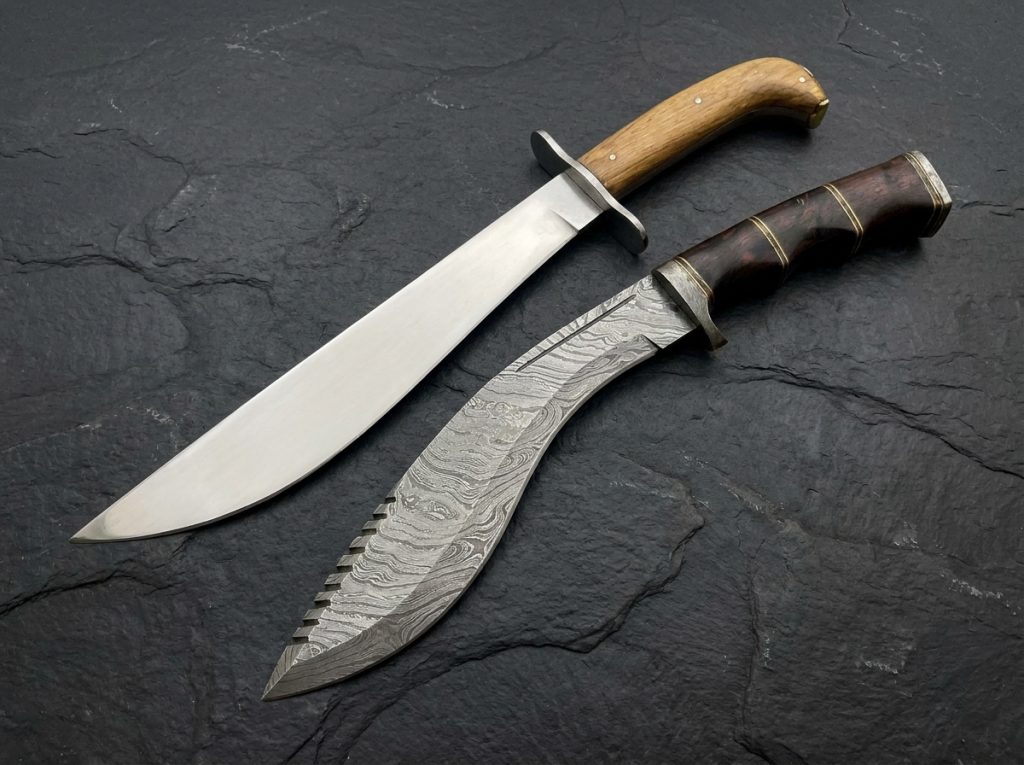
The kukri is a Nepalese blade. The curve it has — that distinctive inward sweep — is not a style choice. It shifts the blade’s center of mass forward. When you swing it, the tip is still accelerating when it makes contact. That is why kukri chopping feels different from swinging a straight knife of the same weight. The blade keeps driving after impact rather than stopping dead on the surface.
The bolo is a Filipino blade, and its origin is agricultural. It was designed for cutting sugarcane, clearing jungle growth, and harvesting crops. The wide convex tip achieves something different than the kukri curve — it creates a belly-heavy blade where the weight loads toward the widest point rather than the forward tip. The result is a blade that sweeps through vegetation with a slicing arc rather than a driving chop. More like a scythe in its cutting motion than an axe.
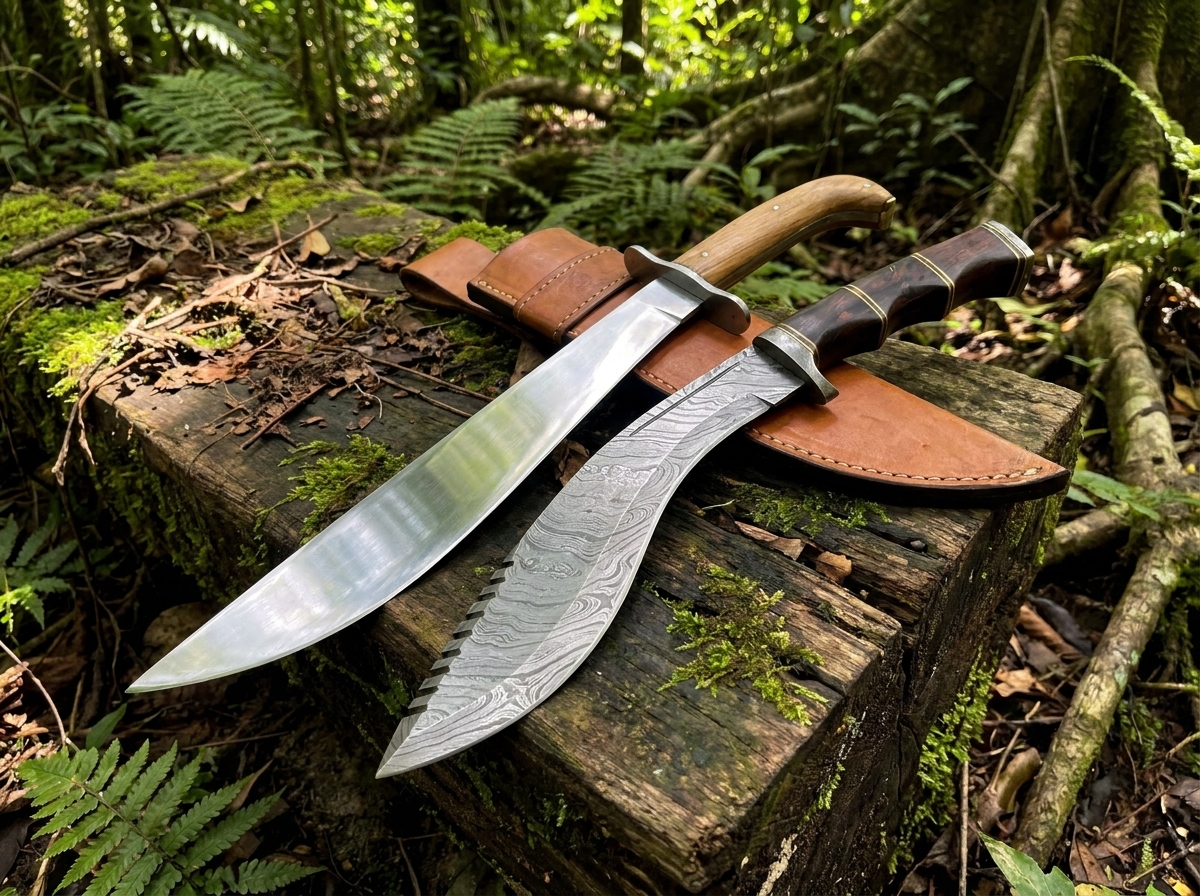
Both blades look similar at a glance — forward-heavy, curved-ish, field tools. In the hand they feel quite different. The kukri has a tighter, more aggressive geometry. The bolo is broader and more relaxed in its weight distribution. Which of those characteristics matters depends entirely on what you are doing.
| Feature | Kukri | Bolo Knife |
| Origin | Nepal — military and agricultural | Philippines — farming and jungle work |
| Blade length | 9-13 inches typical | 10-18 inches typical |
| Blade shape | Inward recurve, forward-weighted tip | Wide convex belly, broad tip |
| Thickness | 5-8mm at spine (thick) | 2-4mm at spine (thinner) |
| Weight | 500-900g | 300-600g |
| Cutting motion | Driving chop — blade accelerates into cut | Sweeping slice — blade arcs through cut |
| Primary purpose | Chopping, survival, wood processing | Clearing vegetation, harvesting, slicing |
| Sharpening | Moderate difficulty — curved belly | Easy — similar to straight knife |
Head to Head — Every Task That Actually Matters
I want to do this properly rather than just listing categories and saying one blade wins each. Because the honest answer is messier than that.
| Task | Kukri | Bolo Knife | Winner |
| Chopping wood | Excellent — tip drives deep into grain | Moderate — tip too wide, deflects on impact | Kukri wins |
| Clearing broad vegetation | Good but tiring over large areas | Excellent — wide sweep covers ground fast | Bolo wins |
| Batoning logs | Excellent — thick spine holds up | Not recommended — too thin at spine | Kukri wins |
| Sugarcane / crop harvesting | Workable but not designed for it | Exceptional — this is what it was built for | Bolo wins |
| Shelter building | Excellent — chops poles, notches, strips bark | Moderate — good on small material, poor on dense wood | Kukri wins |
| Jungle brush and vines | Good — powerful but short strokes needed | Excellent — wide blade sweeps through efficiently | Bolo wins |
| Food prep at camp | Workable on the belly | Better — wider blade surface more useful | Bolo wins |
| One-blade survival carry | Replaces hatchet + knife + machete | Strong on clearing, weak on wood processing | Kukri wins |
| Sharpening ease | Moderate — curve needs rolling wrist | Easy — wider bevel, flatter grind | Bolo wins |
| Cold weather / wet conditions | Thick steel more durable in cold | Thinner blade less forgiving of stress cracks | Kukri wins |
| All-day agricultural work | Heavy — arm fatigue after hours | Lighter — manageable for full working days | Bolo wins |
| Pack carry and weight | Sits flat on belt, balanced carry | Longer — more awkward on moving pack | Draw |
Kukri wins six, bolo wins five, one draw. But I want to point out something that the numbers do not capture. The categories the bolo wins — vegetation clearing, harvesting, food prep, sharpening, all-day agricultural work — are the categories that matter if you spend most of your time cutting vegetation rather than processing wood. If your outdoor work is heavily land clearing and crop work, the bolo wins the comparison in practical terms regardless of the score.
Where the Kukri Genuinely Has No Competition
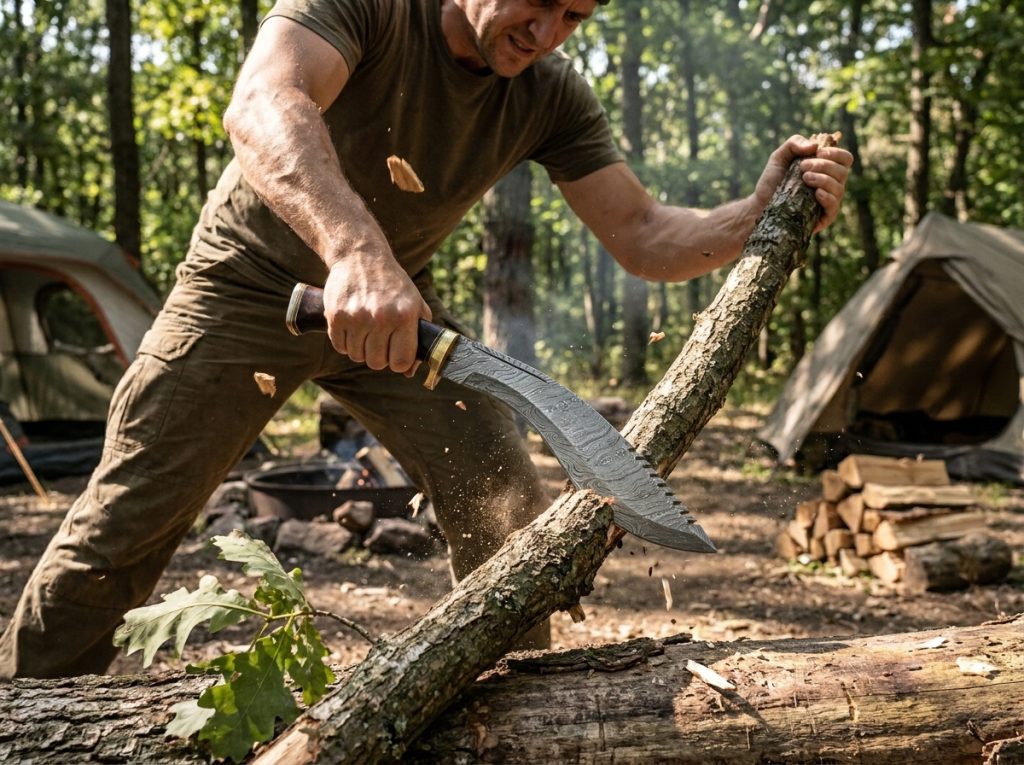
Wood processing. That is the short answer. The moment you need to split, baton, or seriously chop through dense timber, the bolo starts struggling in ways the kukri does not.
I tested this directly — not with a stopwatch and charts, just by doing the actual work and paying attention. Processing green wood for an overnight fire, I could do it faster with the kukri than with a bolo of similar weight. The bolo tip is too broad to drive cleanly into the grain. It deflects and loses depth with each stroke. The kukri tip drives in and keeps going.
Batoning is the other place where the difference is stark. You cannot safely baton with a bolo. The spine is too thin and the geometry is wrong — the wide flat face of the blade does not split wood the way the kukri’s narrower profile does. Batoning a kukri through a 5-inch log is routine. Doing it with a bolo risks folding or cracking the blade.
Shelter building also goes to the kukri, and this one surprised me a little. The kukri’s belly does precision work — notching, stripping, trimming — that the bolo’s wide blade handles clumsily. The bolo wants to sweep. The kukri can sweep and also control. That combination makes camp and shelter work faster.
| Field note: On a wilderness course last year, a student wanted to use a bolo for the shelter-building exercise. He had used one before in the Philippines and was confident. He finished the shelter about 45 minutes behind everyone using kukris. The notching was the problem — the wide blade kept skidding off the notch rather than cutting it cleanly. He told me afterwards he should have brought the kukri. |
When specifically to reach for the kukri over the bolo:
- Processing firewood — splitting, batoning, making kindling from green wood
- Building overnight shelters — poles, notching, bark stripping
- Survival situations where you carry one blade and need it to do everything
- Cold environments where thin steel is more vulnerable to stress
- Dense woody undergrowth and saplings over 1 inch diameter
Where the Bolo Has the Kukri Beat — And It’s Not Nothing
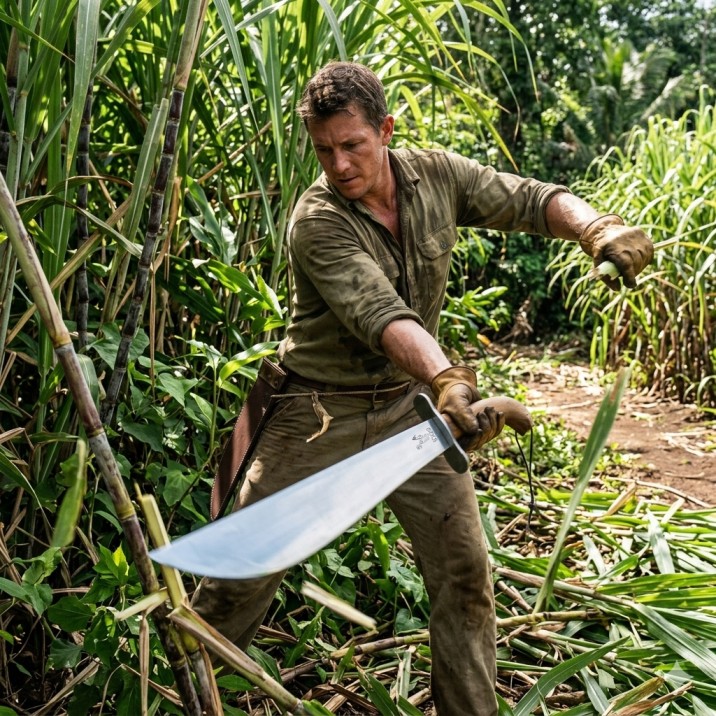
The village market in the Philippines where I held that bolo — the man using it on coconut husks was done in about eight seconds per husk. He was not being careful or deliberate. He was working fast because the blade was doing what it was designed to do. I tried it. Slow, awkward, I kept catching the wide tip wrong.
There is a rhythm to the bolo that the kukri does not have for that kind of work. Wide sweeping cuts through vegetation, long arcs that cover a lot of surface area per swing. Clearing a large patch of sugarcane or jungle undergrowth — the bolo is genuinely faster. The wide belly collects more material per stroke. The kukri’s narrow tip punches through but covers less width.
For all-day agricultural work, the weight difference also matters. A kukri at 700-900g is noticeably heavier than most bolos. Over a full workday of clearing and harvesting, that weight adds up. Filipino farmers who use a bolo daily are not choosing it randomly — it is optimized for the work they do.
Food prep is another honest bolo win. The wide blade surface is better for chopping vegetables and working at a camp kitchen than the kukri’s narrow curved profile. Not dramatically better, but enough to notice. Maybe it’s just me, but the bolo feels more natural doing camp food prep tasks.
| Common mistake: I see people buy a bolo thinking it is basically a kukri with a different profile. It is not. If you bring a bolo to a wilderness trip expecting it to handle firewood the way a kukri does, you will be frustrated. The bolo’s spine is thinner, the tip geometry is wrong for driving into wood, and batoning will damage it. Know what you are buying it for. |
When specifically to reach for the bolo over the kukri:
- Clearing large areas of light to medium vegetation efficiently
- Farm work, harvesting, or land clearing where sweeping cuts dominate the session
- All-day work where a lighter blade reduces fatigue over hours
- Tropical or jungle environments where vegetation clearing is the main task
- Food prep at camp when you want more blade surface to work with
Why the Tip Shape Changes Everything — The Physics Part
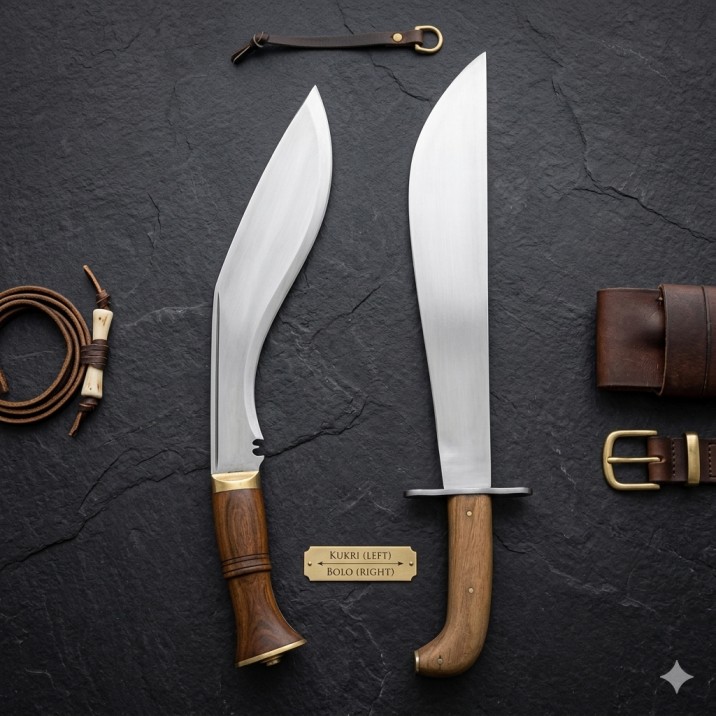
People talk about these blades as if the curve is the defining feature. It is not. The tip shape is.
The kukri’s tip comes to a relatively narrow forward point — narrower than the widest part of the belly. When that tip enters wood, it creates a small initial contact point that the rest of the blade widens as it drives deeper. Think of it like a wedge: narrow at the front, wider behind. The wood splits around the blade rather than deflecting it.
The bolo’s tip is the widest part of the blade. When it contacts wood, the broadest section hits first. There is nowhere for the wood to go except back — it resists and deflects the blade rather than channeling around it. This is not a failure of design. For cutting sugarcane stalks, grass, and soft vegetation, you want that wide initial contact. You want the blade to sweep through with maximum cutting surface. It is only when you ask the bolo to do something it was never intended for — drive into hard dense grain — that the wide tip becomes a problem.
This one geometric difference explains almost every practical distinction between these two blades. The kukri is designed to penetrate. The bolo is designed to sweep. Neither is wrong — they just solve different cutting problems.
Sharpening — Worth Mentioning Because It Comes Up
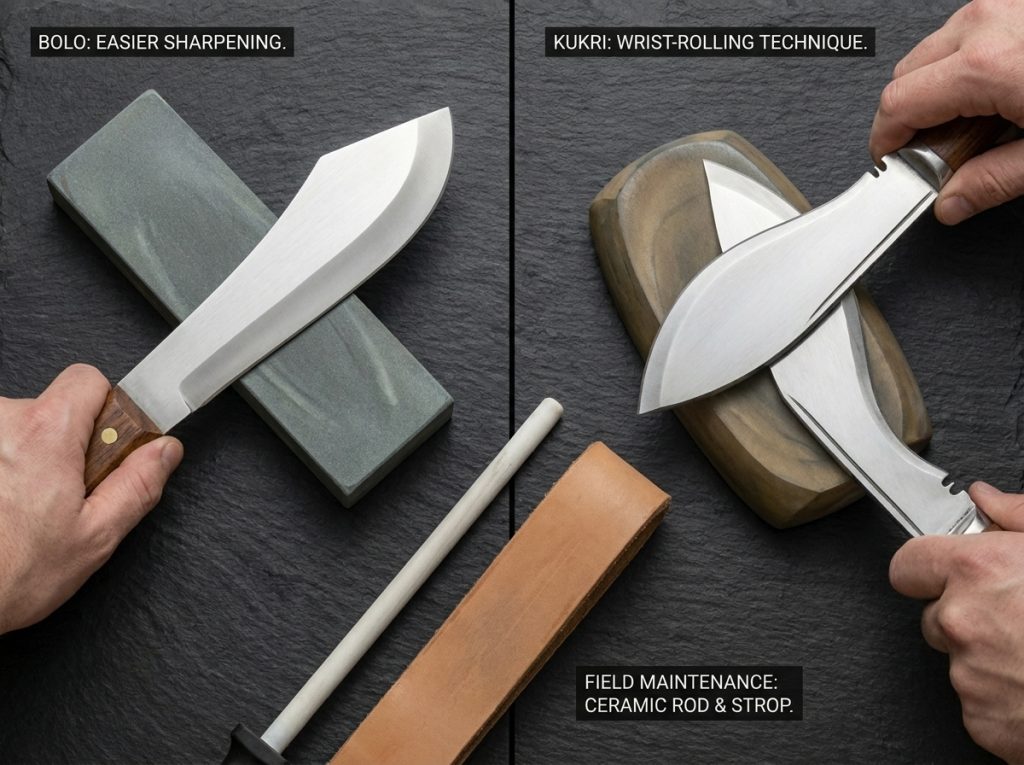
The bolo is easier to sharpen. Genuinely easier. The wider, flatter grind means a flat whetstone at a consistent angle is all you need. Fifteen minutes and you have a working edge.
The kukri requires the wrist-rolling technique along the curved belly. Not difficult once you learn it, but it takes a few sessions to feel natural. The first time most people try to sharpen a kukri they make it duller. This is not the kukri’s fault — it is just a curved edge behaving like a curved edge.
For field maintenance, both blades work fine with a ceramic rod and leather strop. The bolo rewards slightly more from stropping because the wider bevel responds dramatically to alignment work at the end of a session.
The Honest Pros and Cons — No Filler
Kukri
| What it’s actually good at | Where it genuinely falls short |
| Drives deep into wood — the tip geometry is purpose-built for it | Heavier than most bolos — arm fatigue on long light-vegetation sessions |
| Handles the full camp task range — chop, slice, clear, prep, build | Curved edge needs practice to sharpen — not a flat-stone job |
| Batoning is safe and efficient on a full-tang kukri | Overkill for agricultural and farm clearing work |
| Works well in cold where thin steel gets brittle | Shorter reach than most bolos on wide sweeping passes |
| One-blade survival tool — replaces hatchet + knife + machete | No hand guard on most models — requires focused technique |
Bolo Knife
| What it’s actually good at | Where it genuinely falls short |
| Wide sweep covers more vegetation per stroke than most blades | Thin spine means no batoning — will flex or crack |
| Lighter weight sustains all-day agricultural and clearing work | Wide tip deflects on hard wood entry rather than driving through |
| Excellent for tropical vegetation, sugarcane, soft stems and vines | Not a survival tool — cannot replace a knife for precision work |
| Easy to sharpen — flat grind responds to any flat whetstone | Limited in cold environments where thinner steel is more vulnerable |
| Wide blade surface is useful for food prep and camp cooking | Longer blades are awkward on a moving pack without dedicated carry |
Who Should Get Which — My Actual Recommendation
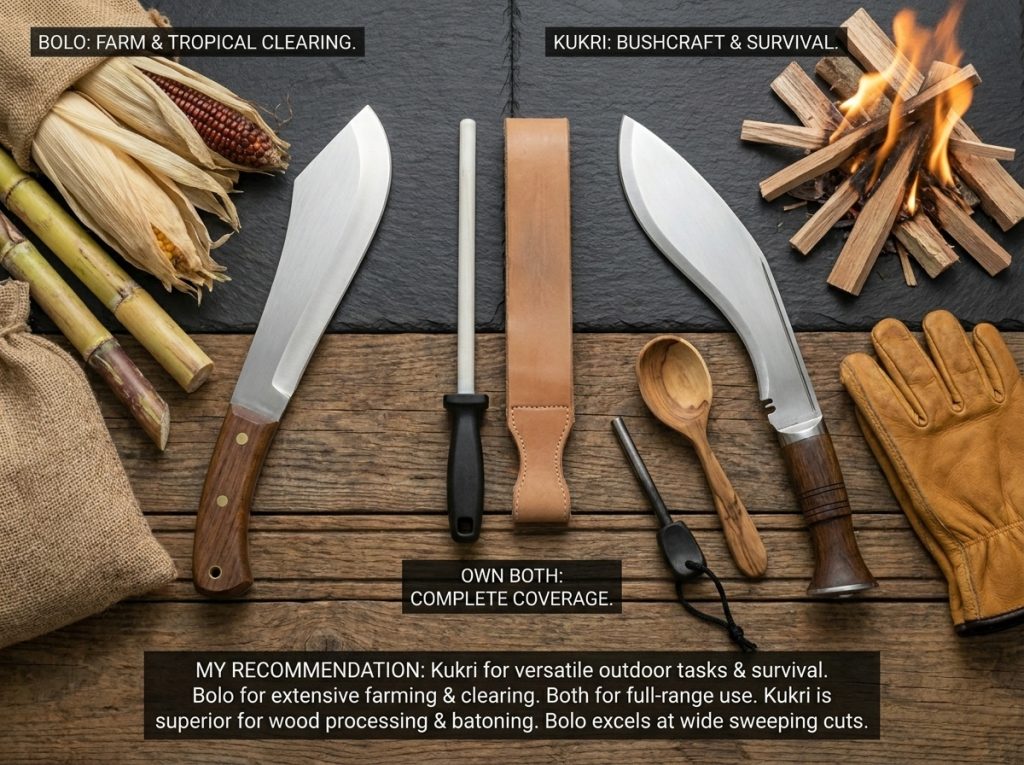
Buy the kukri if you camp, do bushcraft, prep for survival, clear woodland or mixed scrub, or want one blade that handles the full range of serious outdoor work. The kukri is the more versatile tool in almost every non-agricultural scenario.
Buy the bolo if you do farm work, land clearing in tropical or subtropical environments, sugarcane or crop harvesting, or any work that is primarily wide sweeping cuts through soft vegetation over long sessions. If that is your actual daily use, the bolo will serve you better than a kukri for those specific tasks.
Own both if your work crosses between those worlds — bush clearing mixed with camp and shelter work. They do not meaningfully overlap in function, so there is no redundancy. The kukri handles the dense hard work, the bolo handles the open clearing sessions. Combined, they cover everything.
My Picks — What I Would Actually Buy
Best Kukri (for most buyers)
| Spec | Detail |
| Model | KA-BAR 2-1249-9 Kukri Machete |
| Blade | 11.5 in, 1085 carbon steel, hollow grind |
| Handle | Kraton G rubber, full tang |
| Sheath | Leather and Cordura combination |
| Price | ~$50 |
| My verdict | Best value kukri for field use. Three years, no failures. |
This is what I recommend to people who want to find out whether a kukri belongs in their kit. Full tang, 1085 carbon steel that handles real work, Kraton handle that stays grippy in cold and wet. The sheath needs upgrading — that is the honest caveat — but the blade itself is genuinely excellent at this price.

Best Bolo Knife (for clearing and agricultural use)
| Spec | Detail |
| Model | Tramontina 18-inch Bolo Machete |
| Blade | 18 in, carbon steel, convex tip |
| Handle | Hardwood, traditional grip |
| Sheath | Basic nylon (upgrade recommended) |
| Price | ~$25-30 |
| My verdict | What the bolo should be — wide, light, efficient at clearing work. |
The Tramontina bolo is a traditional working tool, not a tactical product or a collector piece. It is light, long, has the wide convex tip that actually sweeps through vegetation, and costs about $25. For someone who needs a bolo for land clearing or farm work, this is exactly right. Nothing fancy, just a functional blade that does the job.

Questions I Actually Get Asked About This Comparison
Is a kukri better than a bolo knife?
For most outdoor and survival uses — yes. For agricultural and tropical vegetation clearing — the bolo is better. They are not competing for the same use case. Pick based on what you are actually doing, not on which blade sounds more impressive.
Can a bolo replace a kukri in a survival kit?
Partially. A bolo handles clearing and light cutting, but it cannot safely baton, it struggles on hard dense wood, and it is not a precision tool for shelter building. In a genuine survival situation where you carry one blade, I would always choose the kukri. The bolo is a clearing specialist. The kukri is a generalist.
What is a bolo knife actually used for?
Traditionally — clearing agricultural land, harvesting sugarcane, cutting through tropical jungle vegetation. Wide sweeping cuts through soft stems and vines over long working sessions. It is a farm tool that also works well for general jungle clearing. Not a survival knife, not a bushcraft blade.
Are bolos and kukris from the same blade family?
No. They look superficially similar — both are field blades with forward weight — but the design logic is different. The kukri is built to concentrate impact force at a forward point. The bolo is built to distribute cutting surface across a wide tip. Different physics, different origins, different intended tasks.
Which is better for self-defense?
The kukri, by a significant margin. The forward-weighted tip and recurve geometry make it naturally effective at powerful downward cuts. The bolo’s wide tip is better suited for sweeping agricultural work than combat. The kukri also has a centuries-long history as both a tool and a weapon — the bolo is primarily a working farm tool. For self-defense specifically, the kukri is the clear answer.
Can I use a kukri for the same tasks as a bolo?
Most of them, yes. A kukri clears vegetation, cuts through soft stems, and handles most tasks a bolo does — just with more effort on wide open clearing passes where the bolo’s sweep is more efficient. The reverse is less true. A bolo cannot do what a kukri does with hard wood and batoning.
What I Actually Think
The kukri is the more useful tool in more situations. If you only own one large field blade and your life is more outdoors and camping than agriculture, buy the kukri and stop thinking about it.
But the bolo is not an inferior product or a lesser design. It is a different design, built for different work, and it does that work better than the kukri would. The village market in the Philippines — that man with the bolo hanging off his belt did not have the wrong tool. He had exactly the right one.
If your outdoor life involves a lot of land clearing, farming adjacent work, or thick tropical vegetation — add a bolo to your kit alongside the kukri. They are not redundant. They genuinely complement each other. The kukri handles the hard work, the bolo handles the sweep.
As with most things in the blade world, the question is not which is better. It is which is better for you, for the specific work you actually do.
| Buy the Kukri if… | Buy the Bolo if… |
| You camp, hike, or do bushcraft | You do farm work or land clearing |
| You process firewood regularly | You clear tropical or subtropical vegetation |
| You want a one-blade survival tool | You need an all-day working tool |
| You need to baton logs | You harvest crops or cut soft stems in volume |
| Cold or mixed terrain is your environment | Warm, jungle, or agricultural environments are your context |
Keep Reading
If this comparison helped, these articles go deeper on specific aspects:
- Kukri vs Machete — the more common comparison, with product picks
- Kukri vs Bowie Knife — when precision cutting matters more than chopping
- How to Sharpen a Kukri — the rolling wrist method that most guides get wrong
- Best Kukri Under $100 — five blades tested, honest verdicts
- Is a Kukri Worth It? — the honest answer after 15 years and 60+ blades
| Marcus Kelvin | Founder & Writer, BestKukriKnife.com 15 years testing kukris. Three trips to Nepal. More than 60 blades through my hands. I write everything on this site myself — no team, no ghostwriters. If it is on BestKukriKnife.com, I tested it. |